In the United States (US), Turboden America LLC, a subsidiary of the technology provider for power generation and heat electrification, Turboden S.p.A., a Mitsubishi Heavy Industries Group company, has announced the installation of what it says is the world's first biochar Waste-to-Energy production plant integrated with a Turboden organic rankine cycle (ORC) technology, marking a significant milestone in sustainable and carbon-negative power generation.
The project in Rhode Island has been developed for Quonset Soil Solutions, LLC (QSS), a waste-to-energy facility established to transform underutilized forestry byproducts into renewable electricity and biochar.
Biochar production by slow pyrolysis of waste vegetal biomass is a very promising way to transform biomass into a valuable product. In addition to biochar, the QSS plant produces electricity thanks to ORC technology. This solution is economically viable in the United States and has a very large potential for application in many countries all over the world, enhancing agriculture and providing distributed power generation. I am very proud of the involvement of Turboden in the QSS project, said Mario Gaia, Founder and Honorary Chairman of Turboden.
Biochar is increasingly recognized as a carbon-negative pathway that delivers climate, environmental, and energy benefits simultaneously.
Produced through the pyrolysis of sustainably sourced woodchips, biochar permanently stores carbon in a stable form, preventing its release into the atmosphere while transforming forestry residues into a high-value resource.
When paired with advanced energy-recovery technologies, biochar production can become a fully self-sustaining, circular industrial process.
This project with Quonset Soil Solutions confirms the ORC’s flexibility and easy integration with the biochar process. It’s the most efficient way to turn woody biomass waste into carbon-negative power and high-quality biochar, said Ilaria Peretti, Senior Business Development Manager at Turboden America.
Residual heat utilisation
At the core of the project is a pyrolysis system that converts woodchips into renewable electricity and biochar. The flue gas from pyrolysis is recovered as a renewable energy source.
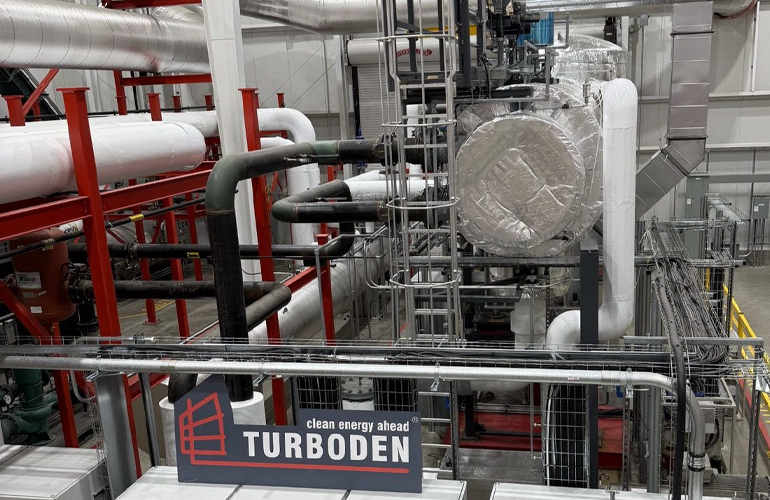
Through a dedicated heat exchanger and thermal oil loop, this waste heat is transferred to a 1.8 MWe Turboden ORC system, which converts it into clean electricity, capturing all the value from the production operations.
The electricity generated by the ORC unit is used to offset the biochar plant’s internal power consumption, enabling QSS to operate independently from the electrical grid.
Renewable electricity generation was a key customer requirement, ensuring energy security, predictable operating costs, and reduced exposure to grid-related emissions.
This project allows us to turn biomass into both renewable energy and long-term carbon storage, while operating as a fully energy-independent, carbon-negative facility. We thank Turboden for the ease of operation and the high energy efficiency delivered by their ORC technology, said Kevin Hirsch, CFO of Green Development LLC, a QSS affiliate.
The entire power plant has been designed to be fully sustainable. The ORC solution requires no patent processes, no highly specialized operators, and no changes to the customer’s core business, making it a straightforward and economically attractive addition.
The project also allows QSS to benefit from the Investment Tax Credit (ITC), enhancing the overall financial performance of the investment.
This state-of-the-art facility delivers multiple benefits, including reduced operating expenditures (OPEX), lower emissions, long-term CO2 sequestration, and full integration into a circular economy model that minimizes air and water pollution. The total amount of CO2 emissions avoided is estimated to be 16,000 tonnes per year.
Award-winning project
By combining ORC-based waste heat recovery with Biochar production, Turboden demonstrates how innovative energy integration can transform waste-to-energy facilities into carbon-negative, energy-autonomous plants, paving the way for a new generation of sustainable industrial solutions.
The project has also been recognized with the Ira W. Leighton, Jr. Outstanding Innovative Technology Award, honoring Quonset Soil Solutions for developing Rhode Island’s first commercial‑scale wood pyrolysis facility that transforms locally sourced forestry residues into biochar and renewable energy through an innovative, collaborative approach.