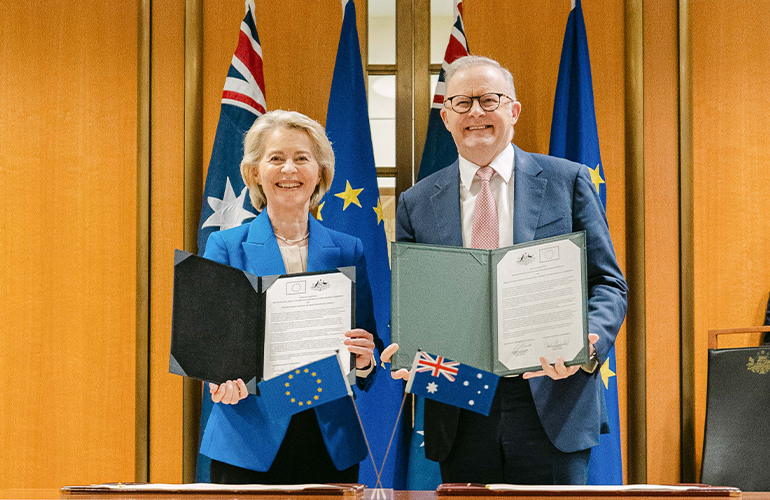
Australia and the European Union (EU) have announced the conclusion of negotiations on "an ambitious and balanced" Free Trade Agreement (FTA) and agreed to launch formal negotiations for Australia's association with Horizon Europe, the world's largest funding programme for research and innovation. The parties also announced the adoption of a groundbreaking Security and Defence Partnership. With these steps, the EU and Australia are delivering mutually beneficial outcomes and further reinforcing their already close relations in a time of geopolitical uncertainty.
The FTA final text was agreed upon on March 24, 2026, during a leaders’ meeting in Canberra, Australia, between European Commission President Ursula von der Leyen, the European Commissioner for Trade and Economic Security, Maroš Šefčovič, Prime Minister of Australia, Anthony Albanese, and Minister for Trade and Tourism Senator the Hon Don Farrell.
Australia’s relationship with the European Union continues to go from strength to strength. After almost 8 years of negotiations, my good friend President von der Leyen and I agreed to the landmark Australia–European Union Free Trade Agreement. I am proud that we have been able to secure this deal, which will deliver benefits for both Australia and the European Union for generations to come. This deal creates major new opportunities for Australian exporters in the European Union’s massive AU$30 trillion economy, and will reduce costs for Australian consumers, said Prime Minister Anthony Albanese.
The Security and Defence Partnership (SDP) was signed virtually by High Representative/Vice President Kaja Kallas and Australian Deputy Prime Minister and Minister of Defence, Richard Donald Marles, and Minister for Foreign Affairs, Penny Wong, on March 18, 2026.
The EU and Australia may be geographically far apart but we couldn’t be closer in terms of how we see the world. With these dynamic new partnerships on security and defence, as well as trade, we are moving even closer together. These agreements put in place lasting, trust-based structures to support peace and security through strength; driving prosperity through rules-based trade, and working together to uphold global institutions. We are committed to building a cleaner, more digital future for our citizens, workers and businesses. And we are sending a strong signal to the rest of the world that friendship and cooperation is what matters most in times of turbulence, said European Commission President Ursula von der Leyen.
A “balanced and ambitious” Free Trade Agreement
With the conclusion of negotiations for “an ambitious and balanced” Free Trade Agreement (FTA), the EU is opening the market to one of the world’s fastest-growing developed economies and thereby bringing significant economic opportunities to European companies, consumers and farmers.
EU exports are expected to grow by up to 33 percent over the next decade, with export value reaching up to EUR 17.7 billion annually.
Key sectors with strong growth potential include dairy (expected to increase by up to 48 percent), motor vehicles (52 percent), and chemicals (20 percent). EU investment in Australia has the potential to grow by over 87 percent.
With this deal, the EU also reinforces its strategic interests in critical raw materials, making EU supply chains stronger and resilient against geopolitical shocks.
The FTA also includes strong sustainability commitments, which will contribute to greener and fairer trade, and ensure that imports into the EU are more aligned with the EU’s own production standards on climate, environmental and animal welfare.
Following recently concluded deals with Indonesia and India, this agreement further diversifies the EU’s network of trade partners in the strategically important Indo-Pacific region and strengthens Europe’s position on the global stage.
Opening business opportunities for European companies
The agreement will give EU exporters privileged access to the Australian market, including:
- Removing over 99 percent of tariffs on EU goods exports to Australia, thus cutting some EUR 1 billion a year in duties for companies of all sizes;
- Opening of the Australian services market in key sectors, including financial services and telecommunications;
- Providing greater access for EU companies to Australian government procurement contracts;
- Setting ambitious rules on data flows, prohibiting data localisation requirements, and
- Securing supply chains for critical raw materials (CRMs) by lowering import tariffs and opening investment opportunities.
In addition, to ensure that small businesses also benefit from the agreement, it contains a dedicated chapter on small and medium-sized enterprises (SMEs) to help them increase their exports.
The agreement will also make it easier for EU professionals to work in Australia, while entry quotas for engineers and researchers will boost European and Australian innovation.
Boosting EU agri-food exports and protecting EU sensitivities
The EU has a positive trade balance for agri-food products with Australia, worth EUR 2.3 billion in 2024.
The agreement will eliminate tariffs on major EU exports such as cheeses, meat preparations, wine and sparkling wine, some fruits and vegetables, including preparations, chocolate, and sugar confectionery.
The agreement takes into account the interests of EU agricultural producers. For sensitive agricultural sectors such as beef, sheep, and goat meat, sugar, some dairy products and rice, the agreement will allow zero or lower tariff imports from Australia only in limited amounts, through carefully calibrated Tariff Rate Quotas.
In addition, the agreement includes a bilateral safeguard mechanism allowing the EU to take measures to protect sensitive European products and their producers in the unlikely event of a surge in imports from Australia causing injury to the EU market.
As an additional layer of protection for farmers, the bilateral safeguard mechanism will be operationalised in a self-standing EU regulation that will see swift and effective protections kick into gear, in the unlikely event of an unforeseen and harmful surge in imports or an undue decrease in prices for EU producers.
Moreover, the Agreement will protect 165 agricultural and food Geographical Indications (GIs) and 231 spirit drink GIs, including some of the most renowned ones such as Comté, Irish Whiskey, Queso Manchego, Salam de Sibiu, Istarski pršut ham, Lübecker Marzipan and Masticha Chiou.
The EU and Australia have also agreed on a modernised bilateral wine agreement, updating the full list of EU wine GIs and traditional terms protected in Australia.
Building on the previous successful agreement, it will offer protection for all EU wine GIs (representing 1,650 names), including the addition of 50 new wine GIs from 12 different Member States.
Securing critical raw materials access
Australia is a major producer of raw materials, including aluminium, lithium and manganese, which are vital for the EU’s overall economic security and competitiveness.
The demand for critical raw materials (CRMs) is projected to increase substantially, and the EU remains heavily reliant on imports.
The deal facilitates EU access to Australian CRMs, with dedicated provisions making the market more predictable and reliable for EU businesses. In addition, special environmental and safety provisions will ensure that these CRMs are extracted sustainably.
Trade in CRMs is currently easily disrupted by sudden economic or geopolitical shocks; therefore, trade agreements with reliable partners are essential for stabilising the EU’s supply.
Ambitious sustainability commitments
The FTA fully integrates the EU’s high standards on trade and sustainable development (TSD), including ambitious commitments on workers’ rights, gender equality, environment and climate.
All TSD commitments in the deal will be enforceable via the agreement’s general dispute settlement mechanism. The deal includes binding commitments on core labour principles and the Paris Climate Agreement, as well as a dedicated sustainable food systems chapter.
The deal also liberalises trade in green goods and services, such as renewable energy and energy-efficient products.
On the EU side, the negotiated draft texts will soon be published and go through the necessary internal procedures before the Commission puts forward its proposal to the Council for signature and its conclusion.
Once adopted by the Council, the EU and Australia can sign the FTA. Following the signature, the FTA requires the European Parliament’s consent and the Council’s decision on its conclusion for it to enter into force. Once Australia also ratifies the Agreement, it can enter into force.
Security and Defence Partnership
The EU and Australia are already long-standing allies and partners, whose global outlook is aligned in terms of defending multilateralism and the rules-based international order.
As the interconnection between security in Europe and the strategically important Indo-Pacific region becomes clearer, the value of a deeper partnership is abundantly clear for both sides.
Building on the strong existing interaction at leaders’ and ministerial levels, backed up by a solid network of expert-level cooperation, the SDP will put in place a robust institutional framework, helping to ensure maximum efficiency in addressing current geopolitical challenges:
- Security and Defence Dialogues will enable closer coordination on strategic priorities, translating shared values and interests into practical cooperation;
- Strengthening cooperation on crisis management and Common Security and Defence Policy missions and operations, including exercises, training and education;
- Enhancing cooperation on maritime security, cyber security, countering hybrid threats and foreign information manipulation and interference, reflecting the evolving nature of contemporary security challenges;
- Facilitating close coordination on emerging and disruptive technologies, including artificial intelligence, as well as on space security, non-proliferation and disarmament;
- Reinforcing exchanges on situational awareness across different regions;
- Supporting capacity building for partners, including in the Indo-Pacific, and strengthening coordination in multilateral and regional fora; and
- Allowing the EU and Australia to deepen cooperation over time in response to evolving security challenges, through a flexible and forward-looking approach.