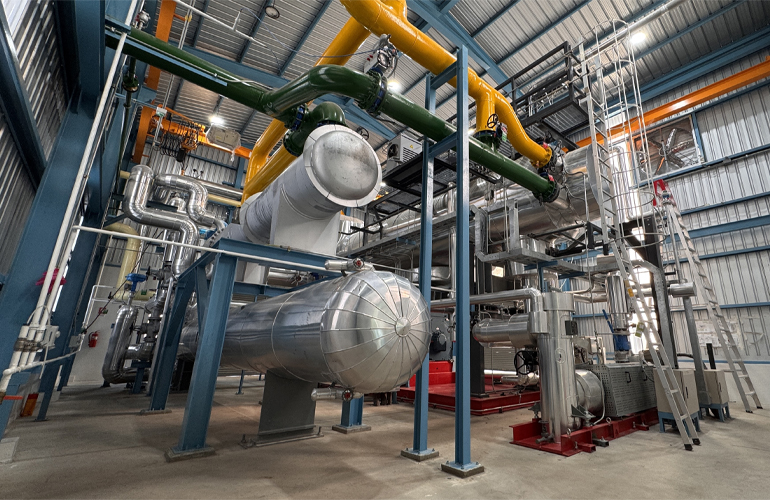
In Thailand, Turboden S.p.A., a Mitsubishi Heavy Industries Group company, has announced the successful start-up of a 1.8 MWe waste-heat-to-power ORC system at the AGC Flat Glass Thailand plant, part of the AGC Group—one of the world’s leading glass manufacturers.
The new installation marks the fifth ORC system delivered by Turboden to the AGC Group. Previous projects include the first system in Italy, followed by installations in Thailand and France (both in operation), and two additional plants currently under construction in India, all ranging between 1.3 and 2 MWe.
With this project, Turboden further consolidates its long-standing collaboration with AGC and its leadership in waste-heat-to-power solutions for the glass industry.
Turboden is proud of this new successful waste-to-heat project in the glass industry. Our first experience in this sector dates back to our collaboration with AGC Italy on their plant in Cuneo, Italy, in 2012. Since then, we have delivered four additional projects within the AGC Group, reaching a total of thirteen ORC plants in the glass industry, including flat glass and container glass, said Paolo Bertuzzi, CEO and Managing Director of Turboden.
Capture inherent waste heat
AGC Flat Glass Thailand produces flat glass for construction and automotive applications.
Facing high energy demand and substantial waste heat generation inherent to flat glass manufacturing, AGC sought to increase energy efficiency, reduce operational costs, and cut carbon dioxide (CO2) emissions in line with its sustainability strategy.
The 1.8 MWe ORC waste-heat recovery system captures high-temperature residual heat from the float glass production process, converts it into electricity for on-site self-consumption.
By transforming an otherwise unused energy stream into CO2-neutral electricity, the system significantly improves overall energy efficiency and plant resilience.
The ORC system reduces greenhouse gas (GHG) emissions by displacing a portion of grid electricity consumption. The expected CO2 emission reduction is approximately 7,845 tonnes annually.
Tailored ORC solution
Turboden delivered an ORC system tailored to AGC’s process conditions, enabling efficient recovery of industrial waste heat and conversion into reliable on-site electricity.
The solution reduces dependence on external power sources and supports AGC’s long-term decarbonization goals.
Today, we consider waste-heat-to-power based on ORC technology a best practice for the glass industry—not only from an environmental standpoint, but also from a technical and economic feasibility perspective. Depending on the configuration, ORC systems can typically generate up to 40 percent of the total electricity consumed by a glass manufacturing plant, working automatically and without adding water consumption, Paolo Bertuzzi said.
JCM-recognized decarbonization project
The initiative also represents a historic milestone – it is the first ORC waste heat recovery project in the glass manufacturing sector selected under the Subsidy Program for the Joint Crediting Mechanism (JCM) Facility Introduction by the Ministry of the Environment, Japan (MOEJ), which provides financial support of up to half of the initial investment cost for projects.
Implemented with the cooperation of the governments of Thailand and Japan, representative project participants are required to conduct measurement, reporting, and verification (MRV) of GHG emission reductions.