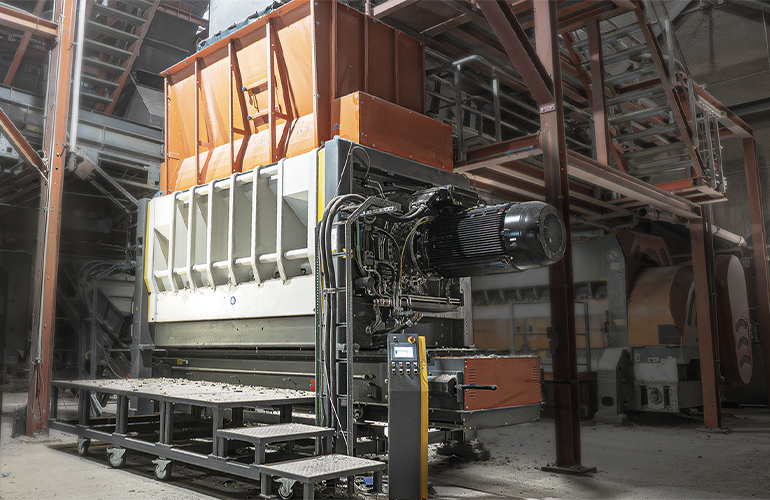
In Germany, KORN Recycling GmbH is modernising its alternative fuel processing operations, prioritising high plant availability, stable throughput rates and consistently high fuel quality. With a new UNTHA SR3000XC secondary shredder integrated into the existing processing line, the company has been producing up to 14 tonnes per hour of high-quality main-burner fuel material, under 25 mm for the cement industry.
Based in Albstadt, KORN Recycling GmbH is one of Germany’s leading waste management companies.
With around 220 employees, eight sites, 66 vehicles and some 5,000 containers, the company operates one of the country’s most modern sorting and alternative fuels processing plants.
Annually, around 100,000 tonnes of waste are processed into approximately 60,000 tonnes of alternative fuels, including high-calorific fluff for the cement industry.
Rapid replacement
As part of the modernisation of one of three secondary shredding units, KORN Recycling opted for the new UNTHA SR3000XC shredder from Austrian material-handling specialists, UNTHA shredding technology GmbH (UNTHA).
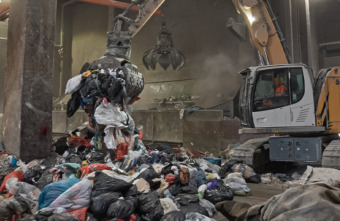
Integration into the existing processing line was straightforward and completed within a single weekend. By the following Monday, the plant was already back in regular multi-shift operation.
The robust shredder is powered by UNTHA Power Drive, a direct drive system with an output of 2 x 250 kW.
The machine processes pre-sorted commercial and industrial waste to a particle size of 25 mm, achieving throughput rates of up to 14 tonnes per hour.
The plant operates on a multi-shift basis six days a week, underlining the machine’s high performance and availability in demanding continuous operation.
A slide-gate-free design meets intelligent material handling
At the heart of the slide-gate-free secondary shredder is the XC cutting unit, featuring a rotor diameter of 1,000 mm and a working width of three metres.
The large rotor ensures continuous self-feeding of the material, meaning that a hydraulic feed pusher is not required. This reduces the number of moving components, minimises potential sources of faults and lowers maintenance requirements.
The newly developed SR FlowGuide optimises material flow within the cutting chamber, reduces material carry-over and shortens residence time within the shredder.
This ensures that the available drive power is utilised efficiently and guarantees a continuous, stable material flow. The result is consistently high output quality, high process stability and increased throughput.
The cutting unit features six rows of strip blades, a total of 84 blades. The cutting tools are designed for four-way use and help significantly reduce wear-part costs and downtime.
In combination with the large screening area and a rotor speed of around 250 rpm, the secondary shredder achieves this high throughput whilst maintaining low wear.
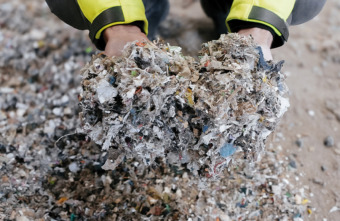
The direct drive replaces the commonly used belt-drive technology. Tasks such as belt tensioning, readjustment, or belt replacement are eliminated, reducing maintenance requirements, increasing availability, and lowering operating costs over the machine’s entire service life.
A maintenance-free safety clutch reliably protects the cutting unit and drive from damage caused by foreign matter.
What you want as an operator of an EBS plant is a stable process with high throughput, smooth operation, consistent output quality and economical running costs. And UNTHA has achieved this very well with the SR3000XC, explained Alexander Korn, Managing Partner of KORN Recycling.
Developed in collaboration with plant operators
Even during the development phase, UNTHA relied on close collaboration with experienced EBS processors. A workshop was held to define the key requirements for a new generation of secondary shredders.
The focus was on a slide-free machine design, a low-maintenance direct drive and a bolted wear plate on the blade holder.
The aim was to create a design with as few wear-prone and high-maintenance components as possible.
In the new SR class, complex processes have been systematically streamlined. The result is a robust and high-performance shredder with high availability and low maintenance requirements, explained Christian Lanner, Head of Research at UNTHA shredding technology.
Operational reliability and ease of maintenance
As secondary shredding represents a key process step within the entire processing chain, the development focused on operational reliability and ease of maintenance.
The robust design and good accessibility of all relevant components shorten service calls and reduce unplanned downtime.
The throughput is high, and the quality of the resulting substitute fuel consistently meets our customers’ requirements at a very high standard. Our customers in the cement industry confirm that we deliver consistently high quality without any outliers. We are very satisfied with the SR3000XC, said Alexander Korn.