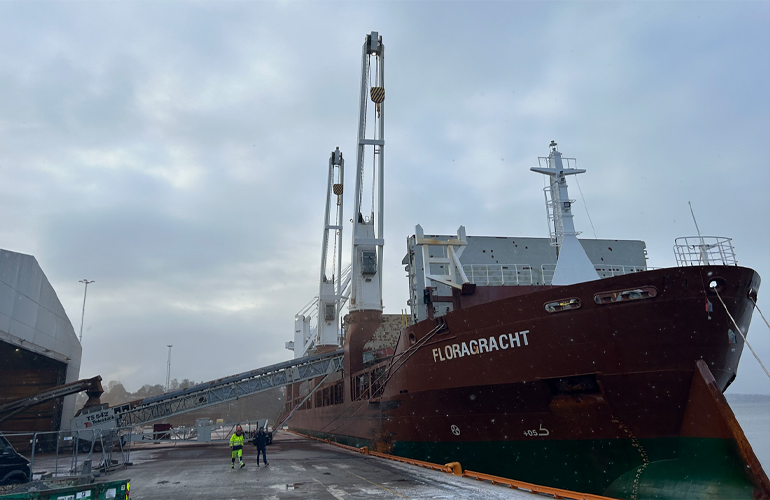
In a milestone event for Norway-based black pellet technology provider and producer Arbaflame AS, the ninth vessel, laden with "ArbaCore" pellets, set sail from the Port of Oslo to an undisclosed energy utility in eastern Canada
According to the company, this event marks a historic achievement in the industry, representing one of the inaugural instances of a ship loaded with biomass energy making its way westward to Canada.
Arbaflame reaffirms its global leadership in black pellet production, with the ninth vessel departing from the Port of Oslo, Norway since the start of production from the new Arba One plant, transporting biomass fuels to international clients.
Previous shipments have reached destinations in France, Belgium, the Netherlands, and Denmark, with Canada and Finland joining the list in early 2024.
Maintaining operational stability, Arba One, the company’s industrial demonstration plant, sees an increase in cargo size, mirroring the growth in production at the plant.
Historically, most bioenergy produced in Canada, in the form of conventional “white” pellets has been exported to Europe and Asia.
The country has now set ambitious climate targets, which include a commitment to reduce greenhouse gas (GHG) emissions by at least 40 percent by 2030 from 2005 levels, with the ultimate goal of achieving net-zero emissions by 2050.
To achieve this, Canada is phasing out coal entirely by 2030, with the carbon tax set to rise to CA$170 per tonne of carbon dioxide (CO2) by 2027.
Canadian authorities actively endorse carbon-negative projects, particularly those centered around bioenergy with carbon capture and storage (BECCS).
Verification test
The upcoming verification test, scheduled for March 2024, at an undisclosed eastern Canadian power plant, aims to showcase the feasibility of replacing coal with renewable biomass fuel.
According to Arbaflame, as part of a significant development program, the end-user in Canada has launched a public consultation, exploring the potential transition of the entire power plant capacity from coal to black pellets.
This aligns with broader initiatives to reduce carbon emissions and boost reliance on sustainable energy sources.
Crucially, the verification test is directly linked to potential future Arbaflame projects and production facilities in Canada.
As Canada is acting on its commitment to greener energy solutions, this initiative emerges as a pivotal example of how power generation can be decarbonized by making use of our technology, and with investments upstream in the supply chain rather than in existing infrastructure, the company said in a statement.