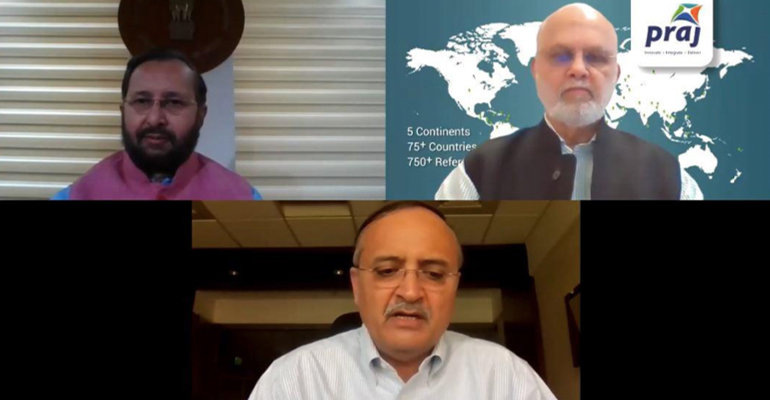
In India, ethanol, and biogas technology developer and provider, Praj Industries Ltd has unveiled a demonstration plant that deploys innovative technology for the production of Compressed Biogas (CBG) from biomass. Located in the Praj Matrix R&D campus in Pune, the plant deploys Praj’s technology which utilizes a proprietary microbial consortium made from feedstock such as agri-residues and press mud and was officially inaugurated on November 6, 2020, by Union Minister Shri Prakash Javadekar.

According to a statement, India currently imports more than 80 percent of its fossil fuel, which is likely to increase to 90 percent in the near future. Transportation is the single largest user of fossil oil and the third-largest greenhouse gas (GHG) emitter.
Further, with India committed to reducing its GHG emissions by 30-35 percent by 2030, it has become imperative to commercialise alternative indigenous energy sources derived from advanced biofuel technologies.
Moreover, biofuels like compressed biogas (CBG) produced from agricultural residues are also an environmentally friendly alternative to uncontrolled field burning of agri-residues post-harvest.
Experienced developer and international supplier
Praj Matrix, the state-of-the-art R&D facility at its headquarters in Pune, State of Maharashtra, forms the backbone for the company’s endeavours towards a clean energy-based bioeconomy.
The company has developed a diverse portfolio comprising of renewable chemicals and materials solutions, bioenergy plants, zero liquid discharge plants, critical process equipment and skids for oil and gas industries, breweries, distilleries, and high-purity water systems.
Praj has focused on the environment, energy, and agri-process industry, with over 750 customer references spanning 75 countries across 5 continents, and has executed more than 50 biogas plants, most of which are operating on industrial waste streams.
Its latest biogas technology, which was officially inaugurated has multi-feed flexibility, is automated and offers several other benefits through its signature licence – engineering, procurement, and construction (L-EPC) and operations and maintenance (O&M) model.
According to Praj, additional advantages include round-the-year biogas production, best-in-class yields, more efficient digestion and biogas upgrading to biomethane, and a low utility footprint. The plant will also co-produce a high-quality digestate, an organic biofertilizer certified by Natural Organic Certification Agro (NOCA).
I am pleased to inaugurate this innovative and indigenous technology that helps secure a cleaner and greener world. Praj’s CBG technology is one of the most sustainable solutions to combat the impact of air pollution on health and the environment because of stubble burning. The conversion of agri-residue and biomass to biofuel is also in keeping with the government’s goals towards Atma Nirbhar Bharat, said Shri. Javadekar, Minister of Environment, Forest and Climate Change; Minister of Information and Broadcasting; and Minister of Heavy Industries and Public Enterprises in his remote address.
A major roll-out of CBG anticipated
In 2018, the government of India launched its National Biofuels Policy as well as the and Sustainable Alternative Towards Affordable Transportation (SATAT) initiative to promote CBG as an alternative, green transport fuel.
Under this initiative, some 5 000 CBG plants are expected to be rolled out across India in a phased manner. Cumulatively, these plants are expected to produce 15 million tonnes of CBG per annum, which is about 40 percent of the current compressed natural gas (CNG) consumption of 44 million tonnes per annum in the country.
In addition, the initiative is estimated to generate direct employment for 75 000 people and produce 50 million tonnes of biofertilizer.