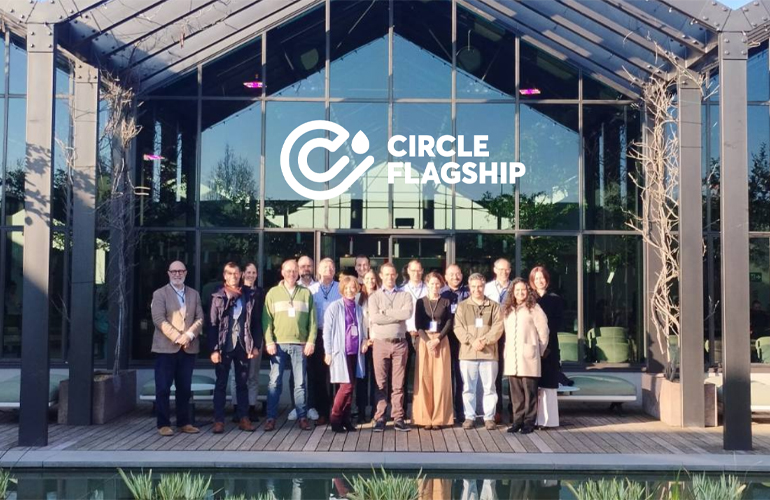
The CIRCLE Flagship project celebrates its first anniversary, marking twelve months of pioneering work in industrial-scale biorefinery retrofitting and circular biobased chemical production. Launched on September 1, 2024, CIRCLE has since delivered a suite of technical, scientific, and outreach milestones, including producing the world's first food waste-based poly-lactic acid (PLA).
CIRCLE (Circular Initiative for Recycling and waste Conversion into Lactate Extracts) is a four-year Innovation Action (September 1, 2024 – August 31, 2028) funded by the Circular Biobased Europe Joint Undertaking (CBE-JU) under Horizon Europe (HORIZON-JU-CBE-2023-IAFlag-02).
Led by TripleW Ltd (Israel), CIRCLE Flagship is being implemented by a consortium of 16 partners from 10 different countries, including: Orgaworld Nederland B.V., a Renewi Group company (The Netherlands), Bio Base Europe Pilot Plant VZW (Belgium), Ecover Coordination Center (Belgium), Volkswagen Group (Germany), Sulapac Oy (Finland), Zero Emissions Engineering BV (The Netherlands), Fibenol ÖU (Estonia), TIPA Corporation Ltd (Israel), Fondazione ICONS (Italy), ΕΤΑΜ S.A. (Greece), FrieslandCampina Nederland BV (The Netherlands), LG Chem Europe GmbH (Belgium), DAVINES S.p.A. (Italy), and Sulzer Management AG (Switzerland).
Significant achievements made
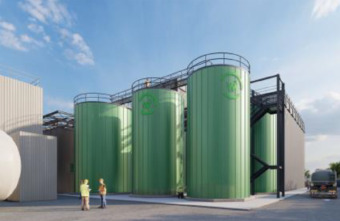
Using core technology developed by TripleW, the project aims to retrofit an existing biogas plant and convert it into an industrial-scale biorefinery to transform food waste streams into high-value biobased chemicals—lactic acid and poly-lactic acid (PLA)—while maximizing resource and energy efficiency.
TripleW has already performed a complete conceptual design study with the support of the Belgian engineering company De Smet Engineers and Contractors (DSEC) for the retrofitting of Orgaworld’s biogas plant.
CIRCLE has completed the Front End Engineering Design (FEED) for the flagship facility.
World’s first food waste-based PLA
In early September 2025, TripleW, in collaboration with Sulzer, produced the world’s first food waste-based PLA bioplastic from TripleW’s lactic acid stream.
The resulting PLA was used to make a cosmetic packaging prototype by Sulapac.
PLA bioplastics are used in a wide range of sectors: from food and beverage packaging and reusable tableware to textile fibers for fabrics, 3D printing filament, and even medical applications.
Using TripleW’s technology, these products can now be made from PLA derived entirely from food waste, reducing reliance on fossil-based feedstocks and helping to combat food waste.
This launch is a critical step towards increased bioplastic adoption in consumer-branded products. TripleW is excited to supply the materials needed for the transition to a truly circular economy. We are proud of our collaboration with Sulzer, demonstrating the growth of highly scalable circular materials together with great partners, commented Tal Shapira, CEO of TripleW.
Using food waste as a feedstock, TripleW delivers a first for the bioplastics industry: a fully circular raw material. PLA’s cradle-to-grave carbon dioxide (CO2) emissions can be up to 75 percent lower than conventional fossil-based plastics, without compromising on excellent properties for its various applications.
Supporting TripleW in the validation and scale-up of their lactic acid produced from food waste into PLA represents a unique milestone in PLA development history. We believe that the industry will benefit greatly from utilizing various feedstocks for biopolymers, and we look forward to the implementation of this process at a greater scale, said Virginie Bellière-Baca, Global Head Technology & Innovation at Sulzer.
This milestone was reached significantly ahead of schedule under the project’s work package six (WP6) and is a critical step in establishing a fully integrated value chain for the production of biochemicals from food waste.