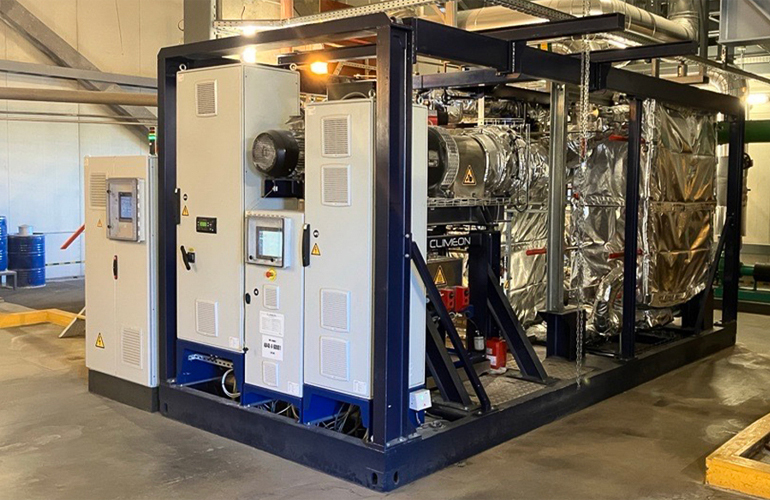
In Lithuania, Climeon’s HeatPower 300 systems at NEO GROUP’s PET resin production facility have reached their first scheduled two-year service interval, marking an operational milestone for Climeon’s latest ORC platform in industrial application.
Located near the Port of Klaipeda, UAB NEO GROUP is one of Europe’s biggest manufacturers of polyethylene terephthalate (PET) granules.
The HeatPower 300 systems installed at NEO GROUP’s PET resin production facility have now generated on-site electricity from industrial waste heat for over two years of operation, reinforcing NEO GROUP’s commitment to sustainable and efficient production.
Following an initial commissioning and optimization period, the systems have maintained approximately 99 percent operational availability and demonstrated stable performance under varying process conditions, including fluctuations in heat source temperatures and flow rates.
The installation generates approximately 2.7 GWh of electricity annually, utilizing excess heat that would otherwise be lost through cooling systems.
The recovered electricity is used on-site, directly reducing NEO GROUP’s purchased electricity demand, contributing to cost optimization and supporting the company’s decarbonization objectives.
Improving energy efficiency and reducing the environmental footprint of our operations is important for NEO GROUP. This installation enables us to recover additional value from our production processes without adding complexity to our daily operations – we can turn waste heat into a valuable energy resource while improving overall efficiency. The combination of reliable performance and close collaboration with Climeon allows us to stay focused on our core business while continuously advancing our sustainability objectives, said Kęstutis Narmontas, Research & Technology Manager, NEO GROUP.
Energy efficiency and sustainability in a changing industrial landscape
Industrial facilities across Europe and globally are facing increasing pressure to improve industrial energy performance as electricity costs, grid constraints, and emissions-related requirements continue to affect industrial competitiveness.
At the same time, large amounts of excess heat generated during industrial processes often remain underutilized.
Climeon’s low-temperature Organic Rankine Cycle (ORC) technology enables NEO GROUP to recover waste heat from condensed process steam without impacting the core production processes, turning previously unused heat into a valuable resource.
For NEO GROUP, investments in energy efficiency solutions play an important role in maintaining industrial competitiveness while reducing environmental impact.
This aligns with broader EU energy efficiency initiatives and supports NEO GROUP’s long-term sustainability strategy.
The successful operation at NEO GROUP clearly demonstrates how industrial companies can turn waste heat into a valuable energy resource to improve energy efficiency and strengthen competitiveness. References like NEO GROUP are important because they demonstrate long-term performance, reliability, and measurable business benefits that industrial companies look for when evaluating new technologies, said Lena Sundquist, CEO of Climeon.