On December 16, 2025, the European Commission presented its Automotive Package proposal to support the sector's clean mobility transition efforts. According to the Commission, the package sets an "ambitious yet pragmatic policy framework" to ensure 2050 climate neutrality and strategic independence while it provides increased flexibility to manufacturers. It also represents the Commission's response to calls by the EU industry to simplify rules.
The automotive sector has been key to Europe’s industrial strength for decades, sustaining millions of jobs and driving technological innovation. As the world is changing, the car industry is transforming through new technologies and actors.
According to the Commission, its Automotive Package maintains a strong market signal for zero-emission vehicles (ZEV), while giving the industry more flexibility to achieve carbon dioxide (CO2) targets, and supports vehicles and batteries made in the European Union.
The corporate vehicles initiative will support the uptake of zero- and low-emission vehicles. The automotive omnibus enhances competitiveness by saving costs, expected to be approximately EUR 706 million per annum, and cutting red tape, while providing greater investment certainty.
Innovation. Clean mobility. Competitiveness. This year, these were the top priorities in our intense dialogues with the automotive sector, civil society organisations and stakeholders. And today, we are addressing them all together. As technology rapidly transforms mobility and geopolitics reshapes global competition, Europe remains at the forefront of the global clean transition, said Commission President Ursula von der Leyen.
Staying the course towards clean mobility with pragmatism
The Commission presents a package that addresses both supply and demand of the automotive sector’s transition: on the supply side, it presents a review of the existing CO2 emission standards for cars and vans and a targeted amendment to those for heavy-duty vehicles (HDVs).
On the demand side, it proposes an initiative to decarbonise corporate vehicles with binding national targets for zero- and low-emission vehicles.
The CO2 standards now provide further flexibilities to support the industry and enhance technological neutrality, while providing predictability to manufacturers and maintaining a clear market signal towards electrification.
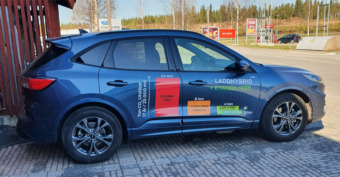
From 2035 onwards, carmakers will need to comply with a 90 percent tailpipe emissions reduction target, while the remaining 10 percent emissions will need to be compensated through the use of low-carbon steel, Made in the Union, or from electro-fuels (e-fuels) and biofuels.
This will allow plug-in hybrids (PHEV), range extenders, mild hybrids, and internal combustion engine (ICE) vehicles to continue playing a role beyond 2035, in addition to full electric (EVs) and hydrogen vehicles.
“Super credits” for small, affordable electric cars made in the EU
Before 2035, car manufacturers will be able to benefit from “super credits” for small, affordable electric cars, made in the EU. This, the Commission says, will “incentivize the deployment of more small EV models on the market.”
For the 2030 target for cars and vans, additional flexibility is introduced by allowing “banking & borrowing” for 2030-2032.
An additional flexibility is granted for the vans segment, where the uptake of electric vehicles has been structurally more challenging, with a reduction in the 2030 CO2 vans target from 50 percent to 40 percent.
The Commission is also proposing a targeted amendment to the CO2 emission standards for HDVs with certain flexibility, easing compliance with the 2030 targets.
Regarding corporate vehicles, mandatory targets are set at the Member State level to support the uptake by large companies of zero- and low-emission vehicles.
Having more zero- and low-emission vehicles on the market, both first- and second-hand markets, will benefit all customers. As companies’ cars cover higher yearly mileages, it also means more emission reductions.
It will also make zero- or low- emissions and “Made in the EU” a prerequisite for vehicles benefitting from public financial support.
Strengthening Europe’s battery industry
With EUR 1.8 billion, the Battery Booster will accelerate the development of a fully EU-made battery value chain.
As part of the Battery Booster, EUR 1.5 billion will support European battery cell producers through interest-free loans.
Additional targeted policy measures will support investments, create a European battery value chain, and foster innovation and coordination across Member States.
These measures will enhance the cost competitiveness of the sector, secure upstream supply chains, and support sustainable and resilient production in the EU, thus contributing to the derisking from dominant global market players.
Less red tape and stronger enabling conditions for the transition
The Automotive Omnibus will ease administrative burden and cut costs for European manufacturers, boosting their global competitiveness and freeing up resources for decarbonisation.
According to the Commission, businesses are expected to save approximately EUR 706 million per annum, bringing the administrative savings thanks to all omnibuses and simplification initiatives the Commission has presented so far to around EUR 14.3 billion per annum.

Among other things, the Commission proposes to reduce the number of secondary legislation that will be adopted in the upcoming years and to streamline testing for new passenger vans and trucks.
This will reduce costs while maintaining the highest environmental and safety standards. The roll-out of electric vans in domestic transport is supported by measures that place them on an equal footing with internal combustion vans regarding drivers’ rest times and rules.
The Omnibus also introduces a new vehicle category under the Small Affordable Cars initiative, covering electric vehicles up to 4.2 meters in length.
This will enable Member States and local authorities to develop targeted incentives, stimulating demand for small EVs made in the EU.
The Commission is also updating and harmonising car labelling rules, for customers to have complete information about the cars’ emissions when making purchases.
Opportunity for sustainable European renewable ethanol if allowed
Commenting on the Commission’s announced proposal, ePURE – the European Renewable Ethanol Association noted that reducing transport emissions “is a goal we all share” and that the proposal “is an admission that betting on only one technology to do this, electrification, was not the way to succeed. The EU needs all workable solutions to reduce emissions from the cars that European consumers continue to prefer and will be driving for a long time.”
According to Commissioner Wopke Hoekstra, who also spoke at the Commission’s presentation on December 16, 2025, this includes biofuels sustainably produced from EU agricultural biomass, such as ethanol.
However, ePURE points out that the EU risks hamstringing its own ambitions yet again if it decides to limit contributions of biofuels and e-fuels to 3 percent, as an optional complementary compensation, to low-carbon ‘Made in the EU’ steel, accounting for 7 percent out of 10 percent of remaining emissions.

According to ePURE, renewable ethanol already provides a 79 percent reduction in GHG emissions compared to fossil fuels.
It is widely available, affordable, and should play an integral part in the defossilisation of EU road transportation, not be “an auxiliary, optional GHG emissions savings crutch.”
Crop-based ethanol already meets the world’s strictest sustainability criteria, and its production does not lead to deforestation or food shortages.
On the contrary, ethanol production is an important part of EU food production. As a recent study from the nova Institut confirms, stymying EU production of crop-based biofuels has dire consequences for EU farmers, removing one of their most important markets, and will thus weaken EU food security.
If the debate on reducing car emissions has proven anything, it’s that Europe needs a more flexible approach to achieving its transport defossilisation goals: one that includes sustainable liquid fuels that reduce emissions now and will continue doing so in the decades to come, the ePURE statement said.