A new study from the International Council on Clean Transportation (ICCT) finds that achieving net-zero carbon dioxide emissions from the aviation sector will not be enough to align aviation with the Paris Agreement. Instead, updated strategies need to include controls on short-lived climate pollutants, such as condensation trails (contrails), nitrogen oxides, and black carbon, to complement existing greenhouse gas mitigation efforts.
The ICCT, an independent nonprofit organization founded in 2001 “to provide first-rate, unbiased research and technical and scientific analysis to environmental regulators”, report comes as the United Nations’ International Civil Aviation Organization (ICAO) gathers in Montreal, Canada, for its 42nd triennial Assembly from September 23 to October 3, 2025.
There, policymakers will debate whether to supplement ICAO’s current 2050 net-zero carbon dioxide (CO2) goal with supplemental targets for SLCPs, notably contrails.
Combined actions could slash aviation warming
The report, “Aviation Vision 2050: The Potential for Climate-Neutral Growth“, concludes that aviation warming from 2025 to 2050 can be slashed by 90 percent by combining action on both short-lived climate pollutants (SLCPs) and greenhouse gases (GHGs).
The study reflects the first deep decarbonization roadmap to reflect SLCP controls and finds that contrail avoidance is modeled to be the most impactful and cost-effective lever, accounting for 40 percent of total avoided warming by 2050.
The good news is that curbing airlines’ climate impact may be easier than most expect. The bad news is that governments aren’t yet prioritizing the low-hanging fruit of contrail avoidance, said Sola Zheng, lead author of the study.
Five scenarios
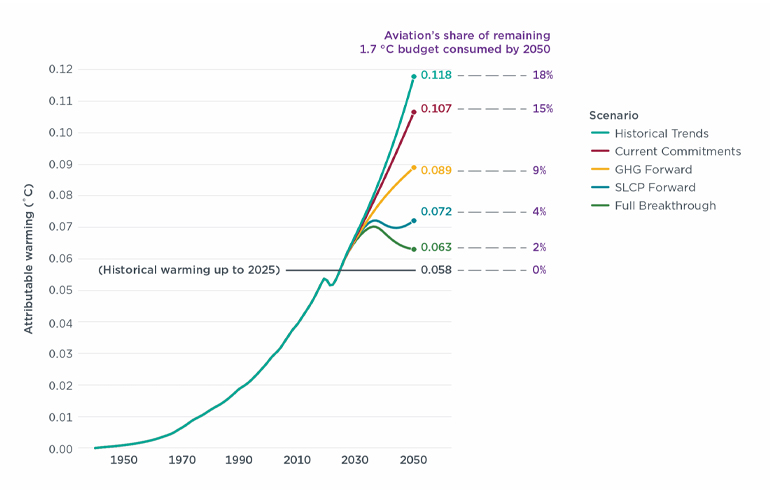
Using advanced modeling tools, the report estimates aviation’s warming potential through 2050 across five scenarios that span the full range of GHG and SLCP control.

Under the Historical Trends scenario, aviation’s contribution to global warming would reach 0.12 °C in 2050, or double the historical contribution up to 2025 (0.063 °C).
Maximum efforts to cut both GHGs and SLCPs are projected to limit additional aviation warming through 2050 to only 0.005 °C, or just 10 percent above the existing contribution.
This would align aviation with the Paris Agreement’s most aggressive (1.5 °C) temperature goal.
Governments and industry are right to invest in clean aviation fuels, which are essential to the long-term sustainability of aviation. But small changes in how aircraft are flown to cut contrails may protect our climate even more in the near and medium-term, said Dan Rutherford, Senior Director of Research at ICCT.
Contrail avoidance, SAFs, hydrotreating, and operational efficiency were found to account for nearly 90 percent of avoidable warming in 2050.
Policy solutions include wide-scale avoidance trials coordinated by air navigation service providers, mandates and incentives for SAF and hydrotreating fossil jet fuel, carbon pricing policies to promote more fuel-efficient operations, and deployment of sustainable aviation fuels.