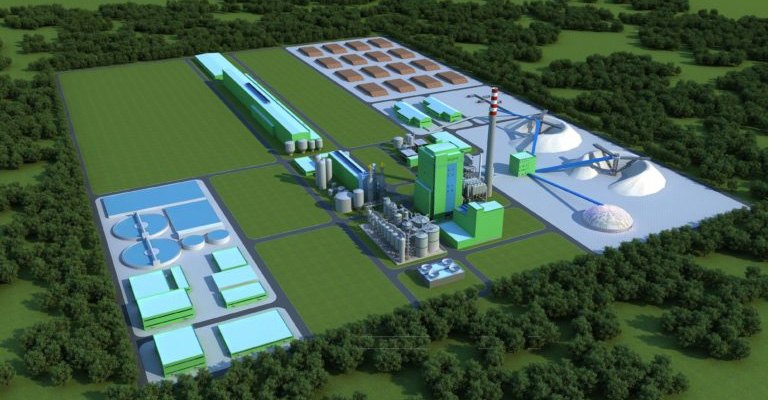
A group of Estonian investors with a long-term forestry and wood industry experience is considering building a modern and environmentally sound biorefinery in Estonia. With its EUR 1 billion investment, it would be the largest ever industry investment in Estonia. After completion, it would be the most modern biorefinery in Europe.
According to Margus Kohava, a recognized forestry industry expert and Aadu Polli who has extensive international forest industry sector experience, the added value created by the bioproducts mill would be EUR 210 to 270 million, which was approximately 1-1,4 percent of Estonia’s entire GDP in 2015.
In comparison with today’s situation where wood is exported to the Nordic countries as a raw material, the biorefinery would increase the value of the wood by 4 – 5 times. The mill would create 200 qualified new direct jobs outside the capital region and in addition 500 – 700 new jobs in the value chain servicing the mill.
The biorefinery would annually increase Estonian export by EUR 250-350 million, while the value of overall exports of Estonian products would grow by 2 to 3 percent. As a result of building the mill, Estonian’s manufacturing industry sector’s average added value would increase by 7-9 percent per employee, explained Kohava. The mill would create 200 qualified new direct jobs outside the capital region and in addition 500 – 700 new jobs in the value chain servicing the mill, said Margus Kohava.
Renewable energy provider
The duo are board members of Est-For Invest OÜ, the Tallinn-based investment vehicle for the biorefinery project. If realised it would become a unique new generation bioproducts mill in Estonia manufacturing products such as market pulp or other bioproducts made from cellulose, hemicellulose, lignin and renewable energy.
The plant would constantly and stably produce 25 percent more renewable energy than its own use for the production process increasing Estonia’s electricity production from renewable energy sources by 34-45 percent.
Mitigate pulpwood and woodchip export
According to the initial prognosis, the biorefinery would launch production in 2022. The annual planned production capacity would be up to 700 000 tonnes of pulp. As feedstock, the mill would require approximately 3 million m3 of pulpwood and woodchips per annum.
This is a volume that Est-For Invest says is currently being exported out of Estonia with 4 to 5 times lower value. The majority of the pulpwood is anticipated to come from Estonia, with supplementary import from Latvia or Lithuania if necessary.

Scouting location and dialogue
Various locations in different parts of Estonia are being analysed as the potential site for building the biorefinery. The prerequisites for the mill include 100 hectares of land, a location close to raw materials with an operating network of roads and rail, an access to a sustainable river water resource and local qualified labour force.
The project feasibility is being analysed in a close cooperation with various Estonian state authorities as well as with well-known scientific experts. Kohava accentuated that the investors would like to have a close cooperation with the public.
It is vital for us to constructively collaborate with all interest groups, scientific communities and potential co-investors to ensure that the mill’s construction, technology and operation would be in accordance with the environmental requirements, be social-economically sustainable and in concord with the interest of the Estonian society, Kohava added.
Prior to the final investment decision, the investors want to ensure that establishing the planned bioproducts mill is in accordance with all environmental requirements. The investors that initiated the research and analysis stage of the project represent 100 percent Estonian capital.
In the later stage, subject to a positive investment decision, investors plan to engage a financial investor and/or strategic investor. It is expected that an international banks syndicate would participate in financing the project. Another possibility is to receive money from the local capital market.
Considering the volume of construction works, it is expected to have a foreign and local construction companies to form a consortium for carrying out the civil construction works.
Investors of the planned bioproducts mill project include Aimar Varula, Arvo Türner, Heiki Vahermets, Peedo Pihlak, Toomas Mets and Virko Lepmets (OÜ Combiwood), Peeter Mänd (Ivard OÜ), Kaido Jõeleht (Kaamos Group), Jüri Külvik (Lemeks Grupp), Mati Polli (Tristafan OÜ) and Tiit Nilson (Woodwell).
The advisors of the project include the international biorefinery expert Daniel Paalsson, the consultant of macroeconomic topics professor Urmas Varblane, law office Raidla Ellex, Estonian Center for Applied Research CentAR and Communication Consultancy JLP.