Swedish power-to-liquids (PtL) project developer Liquid Energy Design Europe AB (formerly Liquid Wind AB) and Germany-based thyssenkrupp Decarbon Technologies have announced a collaboration to advance the development of large-scale electro-fuel plants in north-east Sweden.
The aim is to develop two initial projects in Umeå and Örnsköldsvik, each designed to produce about 100,000 tonnes of e-methanol per annum from renewable electricity and biogenic carbon dioxide (bioCO2) for use in aviation, shipping, and road transport.
Under the collaboration, Liquid Energy Design intends to complete the development of the flagship projects, originally initiated during the Liquid Wind era, starting with Umeå and Örnsköldsvik.
We have worked with our committed energy partners in northern Sweden for several years. Bringing one of Europe’s leading technology and EPC companies into the team is an important step forward for these projects and strengthens our ability to move them towards implementation, said Claes Fredriksson, CEO, Liquid Energy Design.
Intended EPC provider
thyssenkrupp’s chemical technology and engineering, procurement and construction (EPC) business, thyssenkrupp Uhde, is intended to provide EPC services for the plants, subject to the projects reaching final investment decision (FID) and the required contractual milestones.
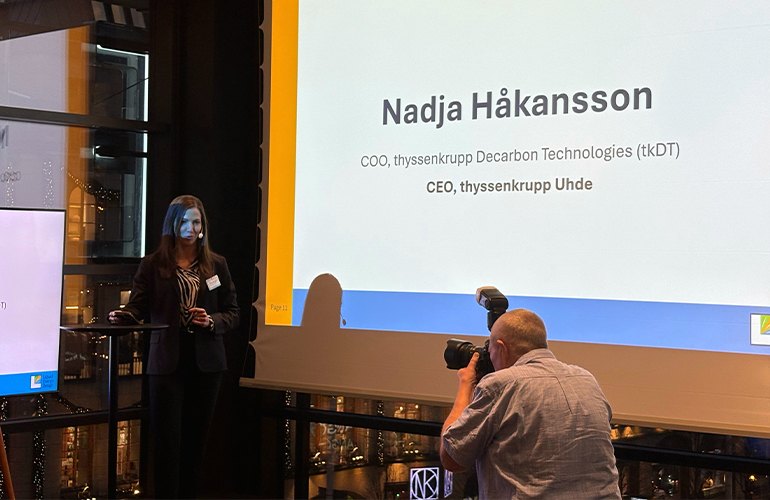
A resilient energy system needs different technologies and energy pathways working together. Power-to-X and e-fuels could add important flexibility by enabling renewable energy to be converted, stored, and transported in different forms. The challenge now is to turn that potential into commercially viable projects that can be integrated and delivered at industrial scale. Together with Liquid Energy Design, our goal is to combine strong local project development and partnerships with our technology and EPC capabilities to help advance promising e-fuel concepts towards investable industrial projects, said Nadja Håkansson, Member of the Executive Board / COO of thyssenkrupp Decarbon Technologies and CEO of thyssenkrupp Uhde.
Municipal biomass-fired CHPs remain as partners
As in the original projects, local municipal energy companies Umeå Energi AB and Övik Energi AB, respectively, are key partners and are expected to provide the sites, the biogenic carbon dioxide (bioCO2) used to produce the fuel, and power grid connectivity.
Örnsköldsvik has a long industrial tradition, and we are proud to provide land, carbon dioxide, and grid connection for its next chapter. Locally produced fuel means investment, jobs and greater resilience for our region, said Roland Nordin, CEO, Övik Energi.
Building a platform for large-scale e-fuel production
Demand for renewable fuels is being supported by increasingly stringent European requirements to decarbonize hard-to-electrify transport sectors. At the same time, energy security and resilient European supply chains have become increasingly important.
Northern Sweden combines access to renewable electricity and biogenic carbon dioxide with established industrial and logistics infrastructure.
Umeå and Örnsköldsvik are important coastal logistics hubs, which could offer favourable conditions for the future production and distribution of renewable fuels.
Access to renewable power and biogenic carbon dioxide is the foundation of every e-fuel plant, and Umeå and Örnsköldsvik offer both. Coming from Denmark, I am struck by the natural potential of this region, and I feel fortunate to work with such a professional and diverse team on a real and relevant challenge, said Benny Mai, CTO, Liquid Energy Design.
Liquid Energy Design is working towards a final investment decision for FlagshipTHREE in Umeå by the end of 2027.
This project fits naturally into Umeå’s energy system, putting our biogenic carbon dioxide, grid and port to new use. Producing fuel here strengthens both the climate transition and the security of supply for the whole region, said Jan Ridfelt, CEO of Umeå Energi.