
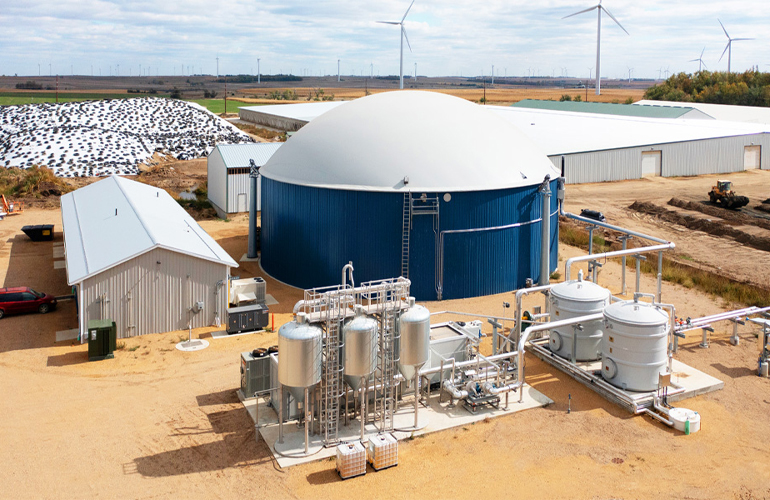
In the United States (US), Clean Energy Fuels Corporation (Clean Energy) has announced that it has completed its latest renewable natural gas (RNG) production facility that is producing pipeline quality RNG and injecting it into the interstate natural gas pipeline grid.
Located at Ash Grove Dairy in Lake Benton, Minnesota (MN), the freestanding one-digester facility will process up to 60,000 gallons of manure daily, capturing the methane and preventing it from entering the atmosphere. This biogas will be converted into an estimated 165 MMBtus of RNG daily.
The Ash Grove Dairy facility is projected to supply up to 480,000 gasoline gallon equivalents (GGEs) of negative carbon-intensity RNG annually when at full capacity and will provide Clean Energy’s stations with clean-burning fuel for its commercial transportation fleet customers.
The project, financed through one of Clean Energy’s production joint ventures and developed by Dynamic Renewables, totaled US$22 million, passed necessary gas testing, and is officially producing ready-to-use RNG.
Clean Energy is in the process of filing the applications to generate federal and state environmental credits.
Ash Grove is our fifth renewable natural gas facility to come online in the last nine months. It’s always rewarding to see our efforts come to fruition when we begin injecting. With the growing demand for RNG, and interest really starting to take off as fleets realize how effective and immediate they can fuel cleanly, the RNG produced at Ash Grove will directly help with reducing carbon emissions across the country, said Clay Corbus, SVP at Clean Energy Fuels Corp.
Agriculture accounts for nearly 10 percent of US greenhouse gas (GHG) emissions and the transportation sector accounts for another 28 percent, according to the US Environmental Protection Agency (EPA).
Capturing methane from farm waste lowers these emissions. RNG, produced by that captured methane and used as a transportation fuel, significantly lowers GHG emissions on a lifecycle basis when compared to diesel.
This allows RNG to be one of the only fuels to receive a negative carbon-intensity (CI) score based on the reduction of emissions at the source and at the vehicle.