
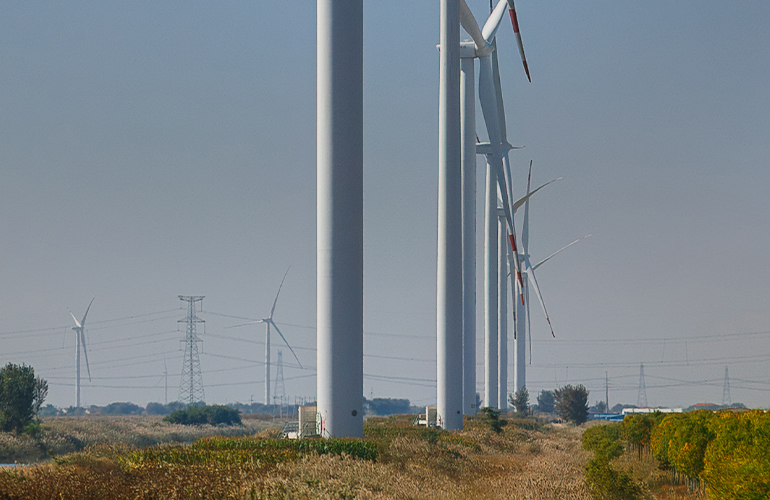
The strategic deployment of renewables has provided enhanced resilience in the face of the current energy crisis by a number of countries, according to a new policy advisory from the International Renewable Energy Agency (IRENA).
Aimed at policymakers responding to the disruption in international energy markets, the “From Energy Crisis to Energy Security Actions for Policy Makers” advisory suggests a set of immediate and longer-term actions to insulate countries and communities from the worst effects of the crisis, and steer their economic recovery towards greater energy security and resilience.
Renewables are already reducing dependence on fossil fuel imports across countries, the new brief finds—from Spain and Portugal in Europe, to China, India, and Pakistan in Asia.
Globally, renewable power capacity continues to grow at record speed, with 692 GW added in 2025.
Furthermore, falling costs have transformed the economics of power generation. More than 85 percent of new renewable energy is now cheaper than fossil-fuel alternatives.
Since 2010, the cost of solar has fallen by 87 percent, onshore wind by 55 percent, and battery storage by 93 percent. Meanwhile, ‘firm’ renewables, which combine wind or solar power with battery storage, provide 24/7 power at lower cost than most fossil-fuel-fired alternatives.
The current crisis clearly demonstrates the strategic case for renewables as a national security imperative. There is an opportunity to prioritise actions that enhance long-term energy stability. Governments must urgently consider targeted interventions to steer investment and emergency responses towards accelerating the deployment of renewable power and the electrification of energy-consuming processes and sectors, commented IRENA Director-General Francesco La Camera.
The ongoing conflict in the Middle East reiterates the inherent structural weakness and vulnerability of national energy systems that remain reliant upon fossil fuels, and markets where the costs of oil and gas are highly influential on electricity prices.
The consequences will extend beyond energy markets and supply chains to affect whole economies, influencing inflation and economic activity simultaneously, with the most pronounced effects likely for the most vulnerable communities around the world.
Country examples in IRENA’s advisory confirm the resilience of renewables. They show the growing role that renewables can play in strengthening energy system resilience and security, reducing exposure to fossil fuel price volatility, and supporting long-term economic stability, Francesco La Camera added.
The brief advises policymakers to:
- Facilitate the deployment of distributed renewables, leveraging cross-sector partnerships to mobilise rapid responses; provide financial and logistical support to fast-track development.
- Use public information campaigns and mandates to reduce energy demand.
- Fast-track time-of-use tariff adoption to enable consumers to shift their electricity consumption to times where renewable supply on grids is high, and prices are low.
- Implement fiscal measures such as grants, subsidies, or tax rebates in support of electrification.
- Accelerate solar PV–battery hybrid mini-grids in off-grid and weak-grid remote areas.
- Accelerate two/three-wheeler electrification in emerging economies; incentivise electrification of public transport through financial and fiscal support; encourage car-pooling where appropriate.
Mid-term actions focus on accelerating renewable deployment while strengthening resilience and investment conditions.
They include fast-tracking renewable and grid projects, ring-fencing funding, and adapting policies to inflation and supply chain pressures. Expanding battery storage, demand-side measures, and grid enhancements will improve flexibility and enable more solar and wind.
Incentives should support heating, electrification, electrich vehicles infrastructure, and sustainable aviation fuel.
In the long-term, clear policy frameworks are needed to attract investments, integrate electrification into national planning, and strengthen domestic supply chains.
Facilitating hybrid projects, supporting industrial electrification, expanding mini-grids, and linking fossil fuel support to meeting renewable targets will be key.