New industry analysis highlights how the biogas industry in the United States matches renewable energy production to different markets and community needs. Over half of America’s biogas is used for electricity generation, even as the share upgraded to renewable natural gas (RNG) has nearly doubled since 2020, according to new data released by the American Biogas Council (ABC).
According to the American Biogas Council (ABC), the data reflects how the American biogas industry is putting captured methane from organic waste to work – producing renewable electricity, renewable heat, and renewable natural gas (RNG) for use in the nation’s natural gas system.
Biogas systems capture this methane before it escapes into the atmosphere and convert it into electricity, heat, or RNG, while recycling the remaining nutrients into natural fertilizer products.
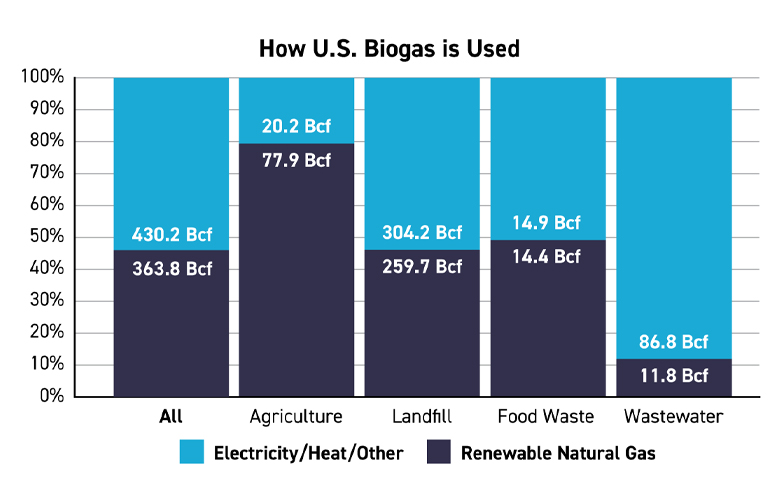
Approximately 53 percent of US biogas is used for power generation, 46 percent is converted to RNG, and just over 1 percent is used to produce renewable heat, illustrating how different sectors use biogas to meet different energy needs.
Dispatchable power
Biogas generates electricity in the same way natural gas does – using gas turbines, combined heat and power (CHP) generators, linear generators, or fuel cells – but biogas-generated electricity is renewable.
It can be used on-site at the biogas facility or added to the electric grid. Once on the grid, this renewable electricity powers homes, businesses, factories, and other users, just like renewable electricity from any other source.
One of the key advantages of biogas-generated renewable electricity is that, unlike solar and wind power, it is dispatchable, i.e., it can be produced whenever needed because the fuel is available on demand.
RNG for heavy-duty transportation
RNG is mostly used in heavy-duty truck engines and helps decarbonize transportation and reduce air pollution.
A smaller portion of RNG goes to utilities that offer it to customers who want to reduce fossil carbon emissions, or producers sell it directly to commercial customers.
ABC notes that the use of captured biogas has shifted significantly over the past five years.
In 2020, only about one-quarter of captured biogas was upgraded into RNG. Today, that share has nearly doubled as new projects increasingly choose RNG as their primary energy product, reflecting changing market opportunities.
One of biogas’s greatest strengths is its flexibility. When America’s waste is converted to biogas, it can generate reliable renewable electricity, provide renewable heat, be upgraded into renewable natural gas, and other uses. That’s a unique advantage as America works to strengthen energy security while reducing methane emissions, remarked Patrick Serfasss, Executive Director of ABC.
The new data also shows that different sectors of the biogas industry use captured biogas in different ways.
Farm-based digesters now direct nearly 80 percent of captured biogas to RNG production, while landfill gas (LFG) projects continue to split production between renewable electricity and RNG.
Food waste facilities increasingly support both end uses. Wastewater treatment plants (WWTPs) present a different picture, with many continuing to use biogas on-site to generate electricity and heat that support plant operations.
Regional differences
The report also highlights significant regional differences. Texas currently converts the highest proportion of captured biogas into RNG, driven by large landfill gas-to-RNG projects.
California – home to the nation’s largest biogas resource – continues to lead in renewable electricity production from biogas.
Looking ahead, the United States has significant untapped biogas potential. ABC estimates that developing the nation’s remaining biogas resources could support more than 17,000 additional biogas systems.
Depending on how the captured biogas is ultimately used, those future systems could generate enough renewable electricity to power approximately 23.7 million homes or enough RNG to meet the energy needs of approximately 27.4 million homes.