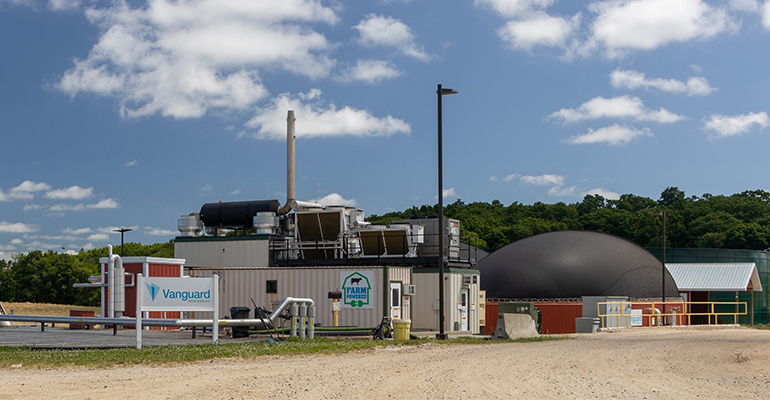
New research published by Vanguard Renewables, a leading US environmental services company and producer of biomethane from organic waste, and portfolio company of Global Infrastructure Partners (GIP), a part of BlackRock, reveals how America’s Heartland is sitting on a massive, untapped energy resource that could transform American agriculture while positioning the United States to "dominate the rapidly expanding maritime fuel market."
According to the white paper, Harnessing the Untapped Energy Potential of America’s Heartland, the analysis shows that using Midwestern agricultural waste—particularly crop residues and food waste—can generate approximately 1,580 trillion Btu of biomethane aka renewable natural gas (RNG), more than eight times the current RNG market.
When upgraded and liquefied, RNG becomes bioLNG, a drop-in fuel that enables conventional LNG to meet international low-carbon requirements without requiring new vessels or infrastructure.
Critical moment
The opportunity comes at a critical moment. The global sustainable marine fuel market is projected to grow from US$13 billion in 2024 to US$836 billion by 2034, and bioLNG is essential to ensuring US LNG remains competitive as the maritime industry shifts away from traditional diesel fuels and lifecycle emissions standards tighten globally.
America’s heartland is positioned to capture a significant share of this market, generating substantial benefits for rural communities and farmers.
However, a critical policy gap threatens to leave this opportunity unrealized. Because ocean‑going vessels are excluded from the Renewable Fuel Standard (RFS), bioLNG used in maritime applications cannot access the same renewable fuel credit value as other fuel uses.
This limits investment signals and risks reducing the long-term competitiveness of US LNG in global markets. Bipartisan legislation has been introduced to address this gap and level the playing field with European regulations.
The Midwest is sitting on a production advantage that can strengthen rural economies and extend U.S. energy leadership for decades. The region has the feedstock, the land, and the proximity to existing infrastructure to scale quickly, but targeted policy action is needed now to unlock this generational opportunity, said Mike O’Laughlin, CEO of Vanguard Renewables and author of the white paper.
Harnessing this potential will bolster infrastructure investments that would deliver a clear triple win for America:
- Rural Prosperity: US$1.1 billion to US$2 billion in additional annual revenue for farmers across the agriculture sector, totaling US$105 billion to US$185 billion through 2050, enough to reduce farm losses by nearly one-third in challenging years;
- Infrastructure Investment: US$120 billion to US$220 billion of investment in production capacity and delivery infrastructure for US RNG and other advanced fuels;
- Job Creation: 390,000 to 680,000 jobs across farming communities, energy infrastructure, and maritime operations.
The white paper includes state-level analysis highlighting where this opportunity is most concentrated and how existing infrastructure could be expanded.
For example, the analysis finds that Ohio (OH) could increase its RNG output roughly sevenfold by incorporating agricultural residues into its feedstock mix.
According to the paper, this opportunity presents a potential for cumulative GDP growth of US$2 trillion to US$3 trillion by 2050.
However, the paper notes that capturing the full value at stake will require coordinated action from policymakers, farmers, agriculture associations, private investors, and local communities.
A successful push will increase both production and export capacity—giving the US another lucrative channel to extend its global LNG leadership.