
A new joint International Renewable Energy Agency (IRENA) and World Resources Institute (WRI) analysis find that urgent action can significantly lower intensities of water withdrawal and consumption, while substantially reducing carbon emissions intensity by 2030.
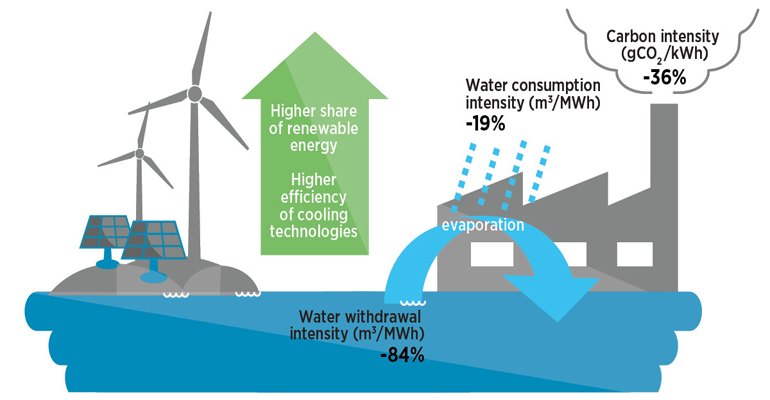
A new policy brief co-authored by the International Renewable Energy Agency (IRENA) and the World Resources Institute (WRI) launched at the World Future Energy Summit 2018 in Abu Dhabi, United Arab Emirates (UAE, finds that increasing the share of renewables, in particular, solar photovoltaic (PV) and wind, in India’s power mix, and implementing changes in cooling technologies mandated for thermal power plants would not only lower carbon emissions intensity but also substantially reduce water withdrawal and consumption intensity of power generation.
The brief, Water Use in India’s Power Generation – Impact of Renewables and Improved Cooling Technologies to 2030, finds that depending on the future energy pathways (IRENA’s REmap 2030 and the Central Electricity Authority of India), a power sector (excluding hydroelectricity) transformation driven by solar PV and wind, coupled with improved cooling technologies in thermal and other renewable power plants, could yield as much as an 84 percent decrease in water withdrawal intensity by 2030, lower annual water consumption intensity by 25 percent and reduce carbon emissions intensity by 43 percent, compared to 2014 levels.
The brief builds off of the findings of Parched Power: Water Demands, Risks and Opportunities for India’s Power Sector“ working paper also launched by WRI.
India has emerged as a global leader in renewable energy achieving record-level growth in deployment, rapid cost reductions and many socio-economic benefits of the energy transformation. Scaling up the use of renewables, especially solar PV and wind, will yield further benefits, in particular, long-term reductions in the dependency of the power sector on freshwater, said Dr Henning Wuester, IRENA Director of the Knowledge, Policy and Finance Centre (KPFC).
More than four-fifths of India’s electricity is generated from coal, gas and nuclear power plants which rely significantly on freshwater for cooling purposes. Moreover, the power sector’s share in national water consumption is projected to grow from 1.4 percent to 9 percent between 2025 and 2050, placing further stress on water resources.
Renewable energy, with the added potential to reduce both water demand and carbon emissions, must hence be at the core of India’s energy future.
India’s move towards renewable energy is essential, especially as water stress puts increasing pressure on India’s thermal power plants. Water risks to thermal power plants cannot be ignored when considering the cost of thermal energy. Renewables, especially solar PV and wind energy, present a win-win solution for both water and climate, said Dr O.P. Agarwal, CEO, WRI India.