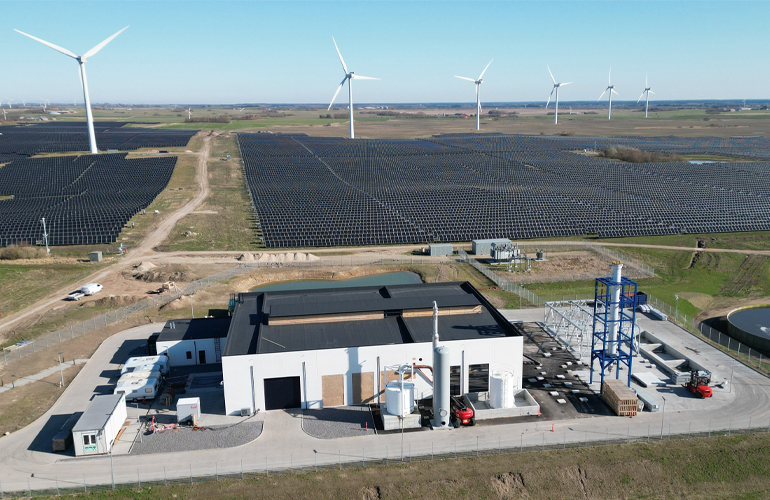
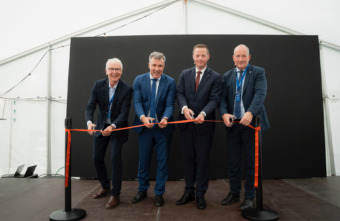
In Denmark, a consortium comprising renewable energy and power-to-X developer Skovgaard Energy ApS, global carbon emission reduction technologies major Topsoe A/S and global wind turbine technology major Vestas A/S have held the official opening of REDDAP, a dynamic Power-to-Ammonia demo plant in Ramme outside Lemvig in Northwest Jutland.
The Renewable Dynamic Distributed Ammonia Plant (REDDAP) in Ramme will demonstrate a dynamic approach, which entails that the Power-to-Ammonia plant will adapt to the inherent fluctuations in power output from renewable power sources in integration with the plant’s electrolysis and ammonia synthesis loop.
This will ensure optimal production and improve cost-effectiveness. With the power coming from renewable sources, the produced ammonia will be labeled as green ammonia.
We have achieved a milestone in Denmark. Until today, we have been able to supply plenty of green power to the power grid but we have not been able to store it or convert it to the needs of industry. We are now able to do just that, when we turn green electricity into green ammonia, explained Niels Erik Madsen, CEO of Skovgaard Energy.
The REDDAP partnership has received DKK 81 million (≈ EUR 11 million) in funding from the Danish Energy Technology Development and Demonstration Program (EUDP).
According to Lars Aagaard (M), Minister for Climate, Energy and Utilities, who officiated at the opening, the technology makes it possible to produce and store green fuels, which will be crucial if the government is to achieve its climate goals for 2025.
With this project, you take the resource that exists in West Jutland and get more out of it. It’s a testament to the fact that investing in green energy is not just about making land available for wind turbines. It can be the very source of the future jobs that need to be developed throughout Denmark. I hope that many others in Denmark realize that we have the source of not only solving the climate challenge but also of future jobs and employment, Minister Lars Aagaard said.
Development is necessary for a greener future
The new plant benefits Denmark’s climate goals and ambitions and contributes to the EU’s 2050 climate neutrality target and the goal of producing ten million tonnes of hydrogen by 2030, which will be used to make green ammonia.
Ammonia – either in the form of low-carbon ammonia or as an electro-fuel (eFuel) – is anticipated to play a critical role in the world’s journey towards net zero.
It can be transported using existing infrastructure; and it has multiple end-uses, not only as a fuel or hydrogen carrier but also to help decarbonize industrial processes like steel and cement production.
With this new facility, we are taking an important step, which will benefit both Denmark and the rest of the world. We need to continue the development of green alternatives for energy-intensive industries and long-distance transportation with research, innovation and action. This project is a unique example of going from good intentions to actively supporting the energy transition, said Kim Hedegaard, CEO of Power-to-X at Topsoe.
The new Power-to-Ammonia plant will produce 5,000 tonnes of green ammonia annually, and serve as a demonstration plant to showcase the technology’s perspectives before scaling up to an industrial scale, as is planned with compatriot energy major Ørsted A/S at Idomlund in Holstebro.
Now we have proved that we can and that we have the courage, the will, and the production capabilities. This makes us ready to store all the energy we have and will have. Hopefully, we can use green energy in hydrogen production for a future hydrogen pipeline to Idomlund. The new plant is intended to prove that we can do what we want. It’s been our way of learning to crawl within Power-to-X – now we can scale it and make Denmark a pioneer. But the continued development requires that the rest of Denmark – especially the politicians – have the courage to continue developing at the same speed if we are not to be overtaken, ended Niels Erik Madsen.