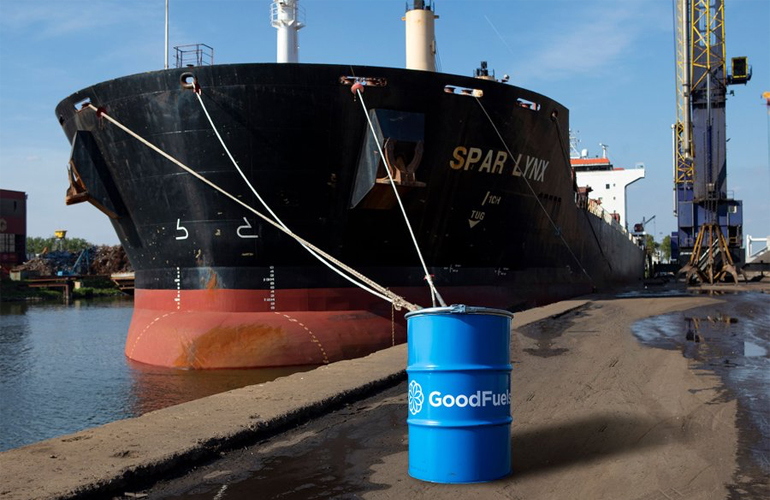
The Netherlands-headed GoodFuels, part of GoodNRG Group a leading biofuels pioneer in the global transport industry, Denmark-headed long-term dry bulk tonnage provider Spar Shipping AS, and Hong Kong-headed ship management leader Fleet Management Ltd have announced the successful completion of a ten-day trial of 100 percent sustainable marine biofuel onboard the Spar Shipping bulk carrier "Spar Lynx".
Spar Lynx bunkered with GoodFuels’ biofuel during its stay in the Port of Dordrecht, the Netherlands, before sailing on to the Port of Icdas in Turkey.
The next-generation sustainable biofuel was derived from a variety of feedstocks certified as 100 percent waste or residue, including processed used cooking oil (UCO) and animal waste fats.
There is particular industry attention on the suitability and applicability of biofuels to legacy tonnage. With regards to Supramax and Ultramax tonnage, which Spar Shipping represents, we consider biofuels may well be the only viable sustainable solution for modern tonnage as well, said Jarle Ellefsen, Managing Director at Spar Shipping.
The trial was the first bio-bunkering undertaken by Spar Shipping and its ship management partner, Fleet Management.
As a tonnage provider, we are looking to facilitate and make feasible sustainable solutions that are technically as well as economically viable. It is all about providing added flexibility to the charterers or operators of existing tonnage, Jarle Ellefsen said.
Emissions reduction
According to GoodFuels, the sustainable marine biofuel supplied by the company delivers a reduction of at least 75 percent in well-to-exhaust carbon dioxide (CO2) emissions.
As a market leader and pioneer, we are proud to supply our sustainable biofuel to Spar Shipping AS as a credible sustainable solution that can match their operational needs, said Dirk Kronemeijer, CEO of GoodFuels.
Over the voyage, Spar Lynx saw an 85 percent cut in sulphur oxides (SOx) emissions when compared to traditional fossil-based marine fuels.
Analysis and continuous monitoring by Fleet Management using a NOx meter supplied by GoodFuels showed the NOx emissions did not increase at a higher speed when using biofuel, contrary to some industry assumptions.
The results from this latest trial further demonstrate the important role of biofuels as a drop-in solution that is available today and makes a tremendous and immediate difference in greenhouse gas emissions. The time for action on shipping’s decarbonization is now, and we are proud to partner with Spar Shipping and Fleet Management as they join the ranks of our marine biofuel pioneers committed to sustainability, Dirk Kronemeijer said.
The trial also further confirmed the safety and technical viability of biofuels for the future fuel mix.
Environmental stewardship is a key area of our Caravel Group and Fleet Management sustainability strategy. We are very pleased that this trial demonstrated a significant reduction in both carbon dioxide and sulphur oxides compared with conventional fuels, said Kishore Rajvanshy, Managing Director at Fleet Management.
Ahead of the trial, Fleet Management undertook a full inspection of the Spar Lynx’s engine to compare the vessel before and after sailing.
As the world’s second-largest ship management company – with more than 600 vessels under our care – we look forward to further contributing to the exploration of the use of biofuels within the global shipping industry, Kishore Rajvanshy said.
Following the voyage, no particulates or differences in engine performance were recorded, which demonstrates biofuel’s ability to seamlessly “drop in” to existing vessels, requiring no changes to existing tanks or engines.
Need for scale-up
Sustainability is also about affordability, and part of the picture is to enable the biofuels industry to scale up and secure both availabilities as well as low-cost sustainable biofuel alternatives for the maritime industry, remarked Jarle Ellefsen.
The sustainable biofuels industry needs takers to be able to scale up, and the maritime industry is looking for availability and low cost. To this end, we all have a role to play. By doing our homework, we de-risk, and we are ready and in a position to offer new sustainable alternative solutions once the regulatory framework allows for it. We have no time to lose if we are to fulfill the expectations placed upon us by the many stakeholders within our industry, ended Jarle Ellefsen.