ST Equipment & Technology (STET), part of Titan America LLC, a subsidiary of global cement major Greece-headed Titan Group has launched a "revolutionary" method for grain ethanol plants to generate high protein dry distillers grains (DDG) and dry distillers grains and solubles (DDGS) co-products using its proprietary water-free separation technology. The STET process uses electrostatic charging and separation to concentrate plant protein, by removing fiber, in DDG.
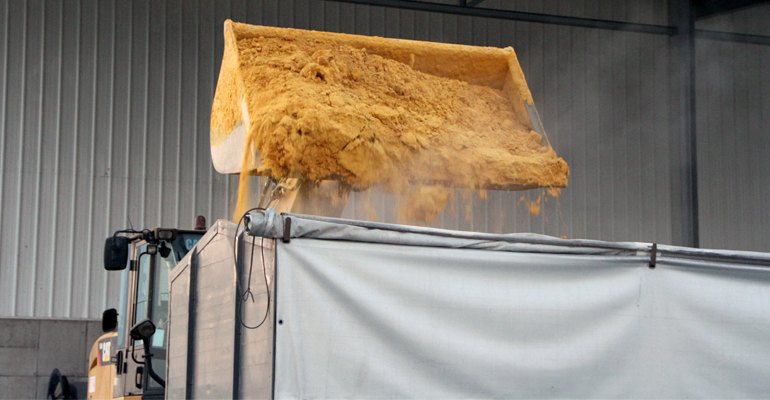
ST Equipment & Technology (STET) is pleased to announce a revolutionary method of generating high protein DDG and DDGS co-products using its proprietary water-free separation technology. The STET process uses electrostatic charging and separation to concentrate plant protein, by removing fiber, in dry distillers grains (DDG).
The result is a 10 percent increase in absolute protein content of the DDG product. This premium high protein product can be used in monogastric feed applications at high substitution ratios. The benefit from this process is that the protein-rich (plus 40 percent protein) DDGS is usable as a higher value feed ingredient and can be sold at a premium.
Electrostatic separation
The operating principle of the STET separator is a proprietary electrostatic separation process used for a wide variety of finely ground, dry granular powders. Electrostatics has a large number of real-world and industrial applications such as fly-ash removal from flue gases in industrial and utility boilers.
In the case of DDGS, protein and fiber acquire opposite electrical charges upon contact with each other – allowing them to be separated from each other in the high strength electric field of the STET separator.
Using this technology offers a method to differentiate ethanol producers’ distillers’ grain by increasing the protein content, and thus the value of the distillers’ grain as a feed ingredient. In a single pass with the STET separator, the protein content of the DDGS is increased by 10 percent absolute, mostly by removing fiber.
According to the company, the STET electrostatic separation process is completely dry, requiring no water or chemicals. It operates continuously, is a high rate (about 15 tons per hour input) and consumes very little energy (about 3-4 kWhr per ton input material). It also works on the DDGS as produced by the ethanol facility – no modification required to the ethanol process.