
In Japan, the consumption of solid biomass fuel for energy purposes has been consistently increasing at a rate of 4-8 percent per annum since 2015, exceeding 25 million tonnes (absolute dry basis) for the first time in 2020. While the Feed-in Tariff (FiT), and its predecessor the Renewable Portfolio Standard (RPS) have spurred an increase in biomass imports, the lion's share is in fact from domestic sources as Takanobu Aikawa, Senior Researcher, Renewable Energy Institute (REI) explains.

Renewable Energy Institute (REI) is a non-profit think tank that through research develops and advocates policies, measures, and financial/business models that are based on the dynamics of markets and society, to promote renewable energy.
REI provides data on the consumption of solid biomass fuels such as woody biomass and palm kernel shells (PKS) in Japan. These are compiled by cross-referencing several different official statistical sources in order to gain a better holistic view of solid biomass fuel deployment in Japan.
Year-on-year consumption increase
Since 2015, the use of solid biomass fuels in Japan has been consistently increasing at a rate of 4-8 percent annually, exceeding 25 million tonnes on an absolute dry basis for the first time in 2020.
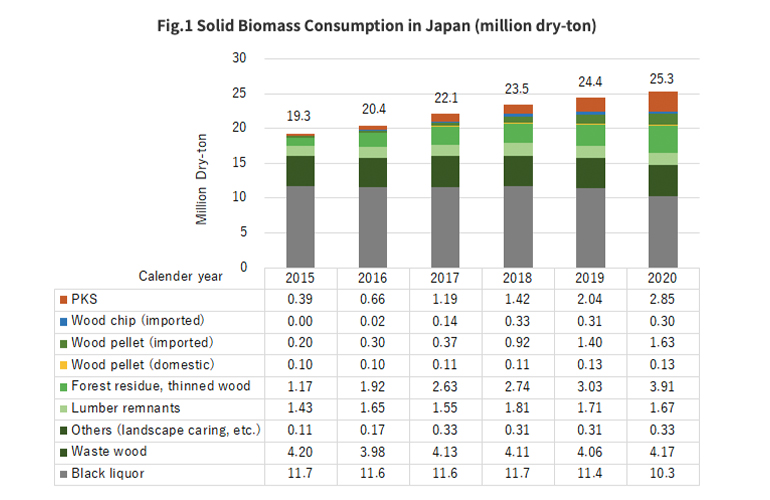
According to REI, the largest growth is seen in the “thinned wood and forest residues” category which more than tripled from 2015 to 2020, reaching 3.9 million tonnes in 2020.
In addition, the use of imported wood pellets and PKS also increased significantly, to 1.63 million tonnes and 2.85 million tonnes, respectively, in 2020.
The increase in these three types of fuels can be attributed to the increase in the number of power plants under the current Feed-in tariff (FiT) scheme.

On the other hand, the “black liquor” and “waste wood” categories – although the former is a liquid, it is a by-product of pulp production while the latter comprised of demolition materials and scrap wood – continue to account for the majority of the biomass, although the amount used remains unchanged, at 10.03 million tonnes and 4.17 million tonnes respectively in 2020.
Black liquor is used for cogeneration of heat and electricity at paper mills but it is fair to say that it is underestimated in terms of energy policy because it is categorized as auto production, said Takanobu Aikawa, Senior Researcher, REI.
Residues from domestic and imported raw materials
According to Aikawa, woody construction material waste was the main biomass power generation fuel under the Renewable Portfolio Standard (RPS) system before the FiT, and it is important in that it can generate power at a low cost.
If we add lumber remnants and other woody biomass such as landscape caring, thinned wood, and forest residues, and wood pellets (domestically produced), we can see that about 80 percent of the total biomass is domestically produced from waste and residual streams. Therefore, it is not accurate to say that imported biomass accounts for most of the biomass. However, if we look at raw materials, the self-sufficiency rate of feedstock in the paper industry remains about 30 percent, and that in sawmills is about 50 percent, Takanobu Aikawa explained.
Aikawa notes that the same issue applies to biomass derived from agricultural products such as livestock and animal manure or food waste, which are imported in large quantities, and can be considered to be a problem in Japan’s primary industry.

Improvement of statistical data needed
The energy use of wood is also found in the Ministry of Economy, Trade, and Industry’s (METI) Total Energy Statistics. However, REI notes that there are some discrepancies between the figures in the Forestry Agency statistics and the Total Energy Statistics.
In addition, the former is based on calendar years while the latter is based on fiscal years, so a simple comparison cannot be made in the first place. REI has aggregated the figures for 2019 and expressed them in energy terms (PJ).
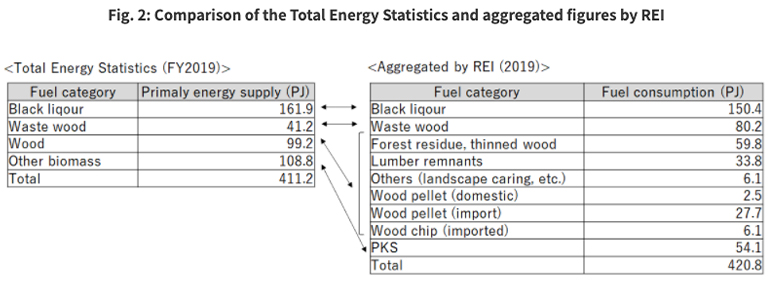
First of all, the total amount of utilization – excluding liquid biofuel (18.6PJ) and biogas (10.0PJ) – is 411.2 PJ in METI’s Total Energy Statistics, which REI notes is consistent with the 420 PJ in REI’s aggregate results.
However, there are many areas where the breakdown does not match, and it would be desirable to clarify the correspondence. Indeed, the 99.2 EJ of wood use in the Total Energy Statistics is nearly consistent with the total value (93.6 EJ) of thinned wood and forest residue (59.8 PJ) and sawn wood (33.8 EJ) from the Forestry Agency. On the other hand, there is a nearly two-fold gap between the 41.2 PJ of waste wood use in the Total Energy Statistics and the 80.2 PJ of construction material waste in the Forestry Agency statistics, Takanobu Aikawa highlighted.
Furthermore, in the Total Energy Statistics, the item “other biomass” has a large amount of 108.8 PJ, which may include construction material waste in the Forestry Agency statistics, in addition to PKS.
There is also a difference of about 10 PJ for black liquor, which REI says, seems to be due to the relatively small number of facilities captured in Forest Agency figures.
Finally, as for imported biomass fuels, wood pellets and PKS can be monitored by trade statistics because the corresponding HS codes can be identified.
However, if new fuels, such as coconut shells, are approved and used under the FiT system, it would be difficult to track the consumption development from trade statistics. Therefore, it is necessary to develop a system to directly collect, organize, and publish fuel data from power plants, ended Takanobu Aikawa.
Facts
About Renewable Energy Institute
Based in Tokyo, Renewable Energy Institute is a Japanese non-profit think tank that aims to build a sustainable, rich society based on renewable energy. It was established in August 2011, in the aftermath of the Fukushima Daiichi Nuclear Power Plant accident, by Son Masayoshi, Chairman, and CEO of SoftBank Corp., with his own resources.