The generation of green hydrogen by water electrolysis represents an exciting decarbonisation opportunity. However, the performance of electrolyzers is heavily impacted by the characteristics and stability of the electrolyzer’s components. A group of engineers in Germany is therefore developing a test bench for alkaline electrolysis.
Hydrogen represents an exciting opportunity as the world seeks to decarbonise its energy infrastructure in the pursuit of a Net Zero goal.
This is because hydrogen has a high calorific value and its combustion products do not emit any greenhouse gases (GHGs) that are considered major contributors to global warming.
However, most hydrogen is currently derived from fossil-fuel-intensive processes, generating ‘grey hydrogen’, which globally accounts for around 2 percent of carbon emissions.
Where hydrogen is generated from the electrolysis of water, powered by renewable energy, the resulting ‘green hydrogen’ offers a significant opportunity for decarbonisation, so there is a high level of interest in efficient, sustainable electrolyzers.
Aggressive operating environment
Alkaline hydrogen electrolyzers use an electric current to split water into hydrogen and oxygen using a liquid alkaline solution such as potassium hydroxide (KOH) as the electrolyte.
Typically, the solution is 15 to 30 percent KOH, which is very aggressive. The electrolyte is contained between two electrodes, typically nickel-based, separated by a porous diaphragm or membrane.
Hydrogen gas is produced at the cathode, and oxygen gas is produced at the anode.
The diaphragm separates the gases and transports hydroxide ions from the cathode to the anode, completing the circuit.
Develop an automated bench test and long-life electrode coatings
However, the performance of electrolyzers is heavily impacted by the characteristics and stability of the electrolyzer’s components.
A joint research project, comprising engineering services provider iChemAnalytics GmbH, the electroplating technology specialist Dr.-Ing. Max Schlötter GmbH & Co. KG, and the coating expert WHW Hillebrand, aim to develop a working, fully automated bench test model for electrolyzer stacks, develop a new electrode coating that is stable for over 80,000 hours, and evaluate prototype coatings over a range of different working conditions.
A key challenge is the ability to accurately and reliably monitor electrolytes in an extremely aggressive solution.
Following a global search for suitable measurement technologies, researchers at iChemAnalytics found that Vaisala refractometers were able to meet their stringent requirements.
Why measure electrolyte strength?
Each side of the membrane in the test bench electrolyzer contains a 30 percent KOH solution – a highly concentrated, strong, and corrosive alkaline liquid that is 30 percent potassium hydroxide and 70 percent water by weight.
During electrolysis, the ratio of KOH percentage on either side of the membrane changes. This is important for multiple reasons.
The service life of the components and the phase boundary reactions within the cells change negatively. This also has a direct influence on cell voltage, aging effects, and reaction efficiency.
Electrolyte measurement technology
The ability to operate in 30 percent KOH at temperatures up to 80°C and pressures up to 5 bar (mounted in-line) ruled out most of the options, leaving either manual laboratory analysis or a small number of technologies based on refractometry or ultrasonics.
Laboratory analysis was ruled out immediately because of the time taken to derive results, which would render process control, and therefore efficiency, impossible to achieve, said Kristian Macke, COO at iChemAnalytics, explaining the decision to use Vaisala’s inline refractometers.
The project team, therefore, evaluated continuous measurement options.
We were particularly impressed by the support from Vaisala’s distributor, Bühler Technologies. They lent us a Vaisala refractometer for a short period so that we could conduct a quick test in our laboratory. They provided CAD files to help integrate the Vaisala device into our test bench, and they provided written confirmation that the refractometer is resistant to KOH permanently, Kristian Macke explained.
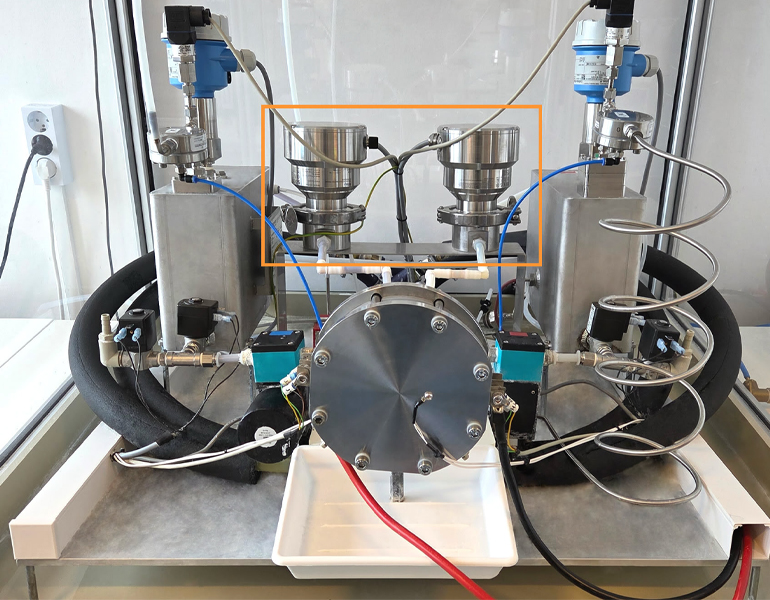
Two Vaisala PR53AC inline refractometers have been installed on the test bench, providing real-time KOH concentration measurements on both sides of the membrane.
This was a significant investment for us, but we have been absolutely delighted with the performance of the Vaisala probes. They were delivered factory-calibrated and were almost plug-and-play. All we had to do was integrate their 4-20 mA output with our PLC, Kristian Macke said.
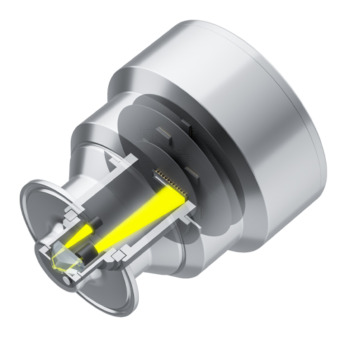
Vaisala refractometers measure the angle of refraction of light in the process medium, using an LED light source.
A sensor continually detects the critical angle at which the total reflection of light commences, and this has a direct relationship with KOH concentration.
Vaisala refractometry is widely used in demanding industrial processes – from chemicals, pulp and paper to food, and pharmaceuticals — where accuracy, chemical resistance, and uptime are critical.
In addition to their ability to operate in harsh conditions, one of the main advantages of Vaisala’s refractometers is that they are not affected by suspended particles, bubbles, or colour, and with the option of automatic prism wash with steam or high-pressure hot water, they are not affected by scaling or fouling.
Project progress
The development of a reliable test bench has allowed the project team to focus on the main objectives of the project, which began in 2023 with a completion target in mid-2026
Different electrode coatings and electrolyte solutions are undergoing accelerated stress testing in a range of temperatures.
The results of a 4-week trial were recently published at a conference in Berlin (ZVO Oberflächentage 2025), where we demonstrated extremely good performance data for a new coating, said Kristian Macke.
As more sustainable coatings are being developed, the new fully automated test bench will allow the team to optimize electrolysis equipment, materials, and conditions in the pursuit of process efficiency.
KOH concentration measurement with Vaisala refractometers is performing a critically important role in the test bench. Clearly, the ultimate goal is to develop new high-performance electrolyzer stacks with high-performance surface coatings, and the ability to automatically monitor and control the KOH ratio will be essential for optimizing electrolyzer components and efficiency, concluded Kristian Macke.