
Fibreco Export Inc., is a leading global supplier of woodchips and operates a wood fibre export terminal in Vancouver, British Columbia (BC), Canada. The company is also arguably one of the largest and longest-running wood pellet export terminals. Celebrating a decade of pellet terminal operation in 2015 the privately held company now finds itself at a strategic investment crossroads.
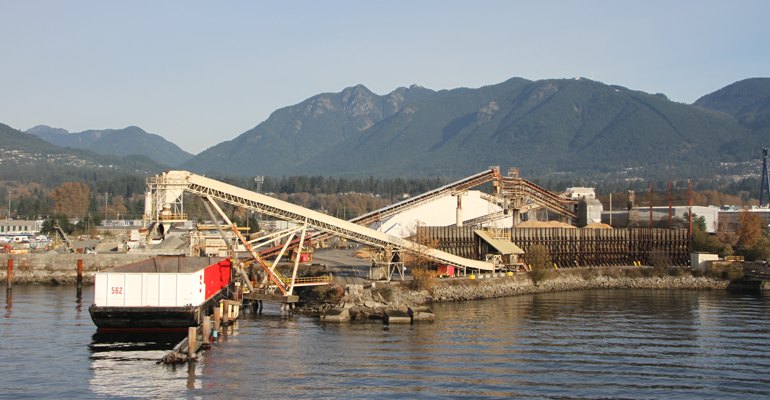
The Fibreco export story starts in 1977 when it was founded as a consortium of over thirty sawmill companies tasked with finding pulp and paper industry export markets for excess woodchips.
In 1979 Fibreco built one of the world’s largest softwood woodchip storage and shipping terminals, a multi-modal terminal serviced by truck, rail, and barge transportation in Vancouver. In 2000 it was restructured as a private company owned by a group of forest companies that operate in the Interior region of the Province.
As such Fibreco has access to significant volumes of softwood woodchips and currently handles four species, Douglas Fir (Pseudotsuga menziesii), Lodgepole Pine (Pinus contorta), and the Spruce Pine Fir (SPF) species mix; White Spruce (Picea glauca), Lodgepole Pine and Balsam Fir (Abies balsamea).
Woodchip for pulp and biomass
As a woodchip trading company Fibreco specializes in the sale, marketing, storage, handling, and trading of woodchips. Given its geographical location, the Asian pulp and paper markets seem an obvious choice taking advantage of some of the fastest sailing times from North America to Asia, typically within 10–15 days.
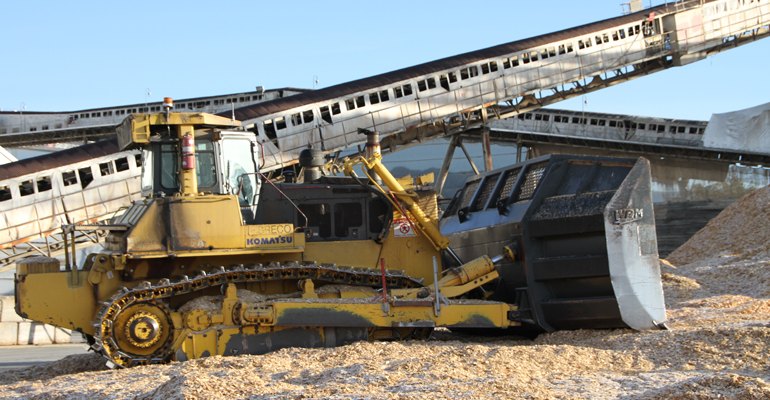
– The Japanese market has always been an important part of our business. We have a highly regarded reputation and excellent customer relationships in the Japanese pulp and paper industry. Our expertise is in providing competitive markets for our wood chip suppliers and in sourcing woodchips for customers in BC, the USA, Asia, and Europe said Kerry Lige, CEO, Fibreco Export during a visit by WPAC conference delegates to the facilities.
From its Port Metro Vancouver site on the north shore of Burrard Inlet, Fibreco ships its own wood chips and provides handling services for third-party woodchip suppliers on a fee-for-service basis.
– As you can see we maintain significant volumes of woodchips on-site to serve our wood chip markets. We have long-term supply contracts with BC sawmills. In addition, we purchase additional woodchips, explained Lige.
The company’s long-standing woodchip trading experience and business relationship with the Japanese pulp and paper industries may well have begun to pay dividends in the energy sector.
In 2010 we added biomass pine woodchips to our product mix. These biomass chips are sold to Japan to replace a percentage of coal in one of the world’s largest power plants, said Lige without elaborating on any details.
Pellet handling
The Fibreco terminal consists of a 9.3 hectare (ha) land site, which unlike most of the other terminal facilities in the Port is owned by Fibreco. The 5.8 ha water lot which accommodates the shipping berth is leased from Vancouver Metro Port.
The terminal can store up to 75 000 bone dry metric tonnes (BDMT) of woodchips and handle the five different woodchip assortments.
In 2005 the company started handling wood pellets destined for the European and Asian energy markets on behalf of the rapidly growing BC pellet industry. To facilitate the new business the company has invested around CA$ 25 million thus far into its pellet handling and storage facilities.
This includes 27 000 tonnes of storage space, in the form of six 4 500 tonne capacity storage silos, that were completed in 2006. An 18 000 tonne flat storage shed was built in 2011 bringing the total pellet storage capacity up to 45 000 tonnes, the equivalent of a Handymax or Supramax vessel.
The terminal is one of the largest and most modern woodchips and wood pellet handling facilities in the world.
Safety and inbound quality
From a terminal operator’s perspective, wood pellets are a difficult product to handle, the product is a fuel specifically designed to burn. Safety and maintaining the inbound quality of the product through each transfer point of the receiving, storage, and ship loading process is a key concern.
Moisture, carbon monoxide (CO), dust generation, and fire are all issues and hazards that need to be addressed, monitored, and mitigated with strict operational procedures, design of handling equipment, detection, alarm, shut down, and extinguishing technology.
– It takes capital to invest in technological solutions and procedures to handle pellets softly and safely. Overall, industry has done a good job reacting to challenges and we believe it is important to be open and share best practices and technology experiences, commented Lige during the safety brief prior to the facility tour.
Weather and vessels
A key infrastructure factor is that the terminal has its own ten-track railway marshaling yard which can hold up to 114 railcars at any one time. The railcar receiving and unloading facility can handle both conventional open woodchip wagons as well as enclosed dry bulk wagons used for pellets.
– We handle over 16 000 railcar movements a year and work very closely with CN Rail to schedule and coordinate the rail movements. CN Rail picks up the loaded railcars from the various producers and transports them to our terminal, said Aaron Crawford, Assistant Manager at Fibreco Exports.
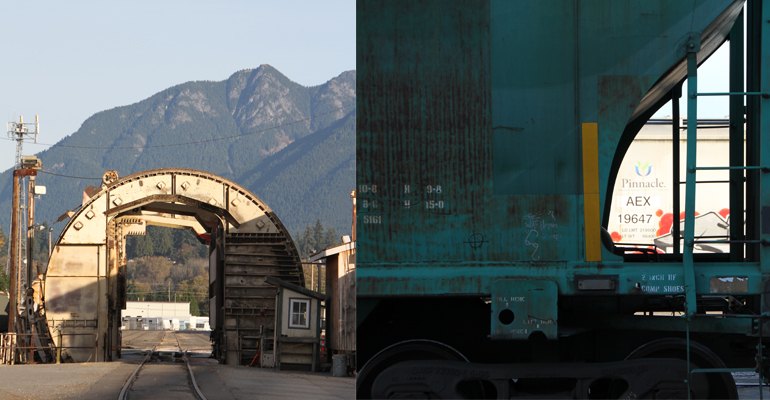
The ship berth can handle vessels up to 210 m in length and with 12.5 m draught, a Handymax vessel capacity, about 45 000 tonnes. Closer to shore is a barge berth for wood chips. The ship berth is serviced with an enclosed conveyor and pneumatic shiploader to facilitate efficient loading, wood chips can be loaded at around 1 000 tonnes per hour whereas pellets can be loaded at up 1 650 tonnes per hour.
– Today we load about 70 vessels a year. Weather is a constraining factor for loading wood pellets. Although the conveying system from the silos and storage shed is totally enclosed, we cannot shipload in rain or snow as the vessels are loaded into open holds, remarked Aaron.
Strategic decision time
On the pellets terminal and handling side, Fibreco finds itself at a strategic investment decision crossroads. Although it has long-term agreements with BC pellet producers, the terminal has seen a significant decline in the volume of pellets being shipped through its facility, from 1.6 million tonnes in 2013 to around 1 million this year.
– This drop has been expected by us and is as you know due to one of our clients taking into operation their own terminal facility, said Crawford, referring to the new Prince Rupert terminal taken into operation early this year by Pinnacle Renewable Fuels.
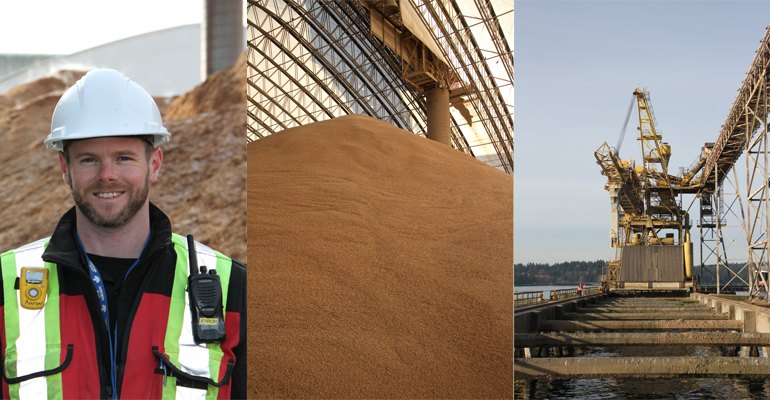
The short-term upside is that it frees up existing pellet storage and handling capacity for other clients looking to increase volume throughput, especially in emerging Asian markets like South Korea and Japan.
– We have additional land available that can be configured to a wide variety of storage options including additional silos, sheds, or open storage depending on customers’ requirements, said Crawford.
Fibreco has already begun to investigate what the future of the current market and Asia demands may hold.
– Coordination of rail delivery, fibre storage, and the loading of barges and deep-sea vessels while maintaining inbound product quality is a key part of our business and provides a high level of value-added service to our customers to ensure a low-cost, efficient supply chain from source to vessel. This allows us and our wood pellet and woodchip handling customers to efficiently and safely deliver quality products to domestic and international customers across Canada, Asia, and Europe, concluded Aaron Crawford.