Closing the recycling loop for materials such as textiles, presents several industry challenges, such as lack of knowledge about the chemical content within the recyclable textile. Therefore, Swedish furniture major IKEA and compatriot retail fashion major H&M Group have teamed up to conduct a large-scale study to better understand how current recyclable textiles measure against existing chemical standards.
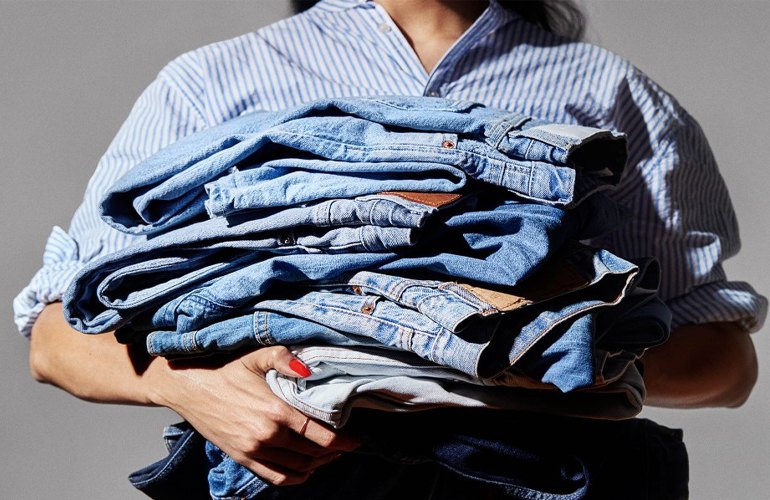
Finding clean and reliable sources of recycled materials is a pre-requisite for any company looking to reach its circular goals. One of the key steps for IKEA in transforming into a circular business by 2030, is to only use recycled or renewable materials.
Increased utilization of recycled materials in products is one of the key elements in H&M Group’s ambition to become 100 percent circular and renewable.
However, as both companies highlight, closing the recycling loop for materials such as textiles, presents a series of challenges, including a lack of recycling technologies, limited availability of collected recyclable textile, and traceability, to name a few.
Furthermore, there are few large scale studies conducted on the chemical contents in collected recyclable textiles.
Joint study reveals challenges and opportunities
IKEA and H&M Group both have the ambition to tackle these challenges, and as a result have collaborated since May 2018 on a large-scale study looking at chemical content in collected recyclable textiles, reviewing the chemical content in post-consumer textile recycling with a focus on cotton as the first step.
The first results of this collaboration were revealed by Anna Biverstål, H&M Group’s Global Business Expert on Materials and Nils Månsson, Materials and Innovation Deployment Manager at IKEA Range and Supply at the 2019 Textile Exchange Sustainability Conference.
This annual event gathers companies and organizations from more than 25 countries thus provides the perfect backdrop to present the joint efforts made to address this challenge.
Recycled materials are key elements in a circular economy. However, increasing the use of recycled materials whilst ensuring that we keep these textiles free of toxic chemicals presents a challenge for the industry. We’re pleased to announce that H&M Group and IKEA have joined forces in a study to address this challenge, said Anna Biverstål, Global Business Expert on Materials at H&M Group.
The aim is to share this knowledge and create awareness among industry members as well as policymakers and legislators, enabling fact-based decisions in the adoption of the circular business model more broadly.
Transforming into a circular economy and making use of recycled materials, requires the industry to have an aligned approach to material development, including which types of substances and levels, are safe. With this study, we want to understand how collected recyclable cotton textile measures against the strict safety standards we have at IKEA, said Nils Månsson, Materials and Innovation Deployment Manager at IKEA Range and Supply.
Next step to include other materials and stakeholders
This study consists of over 8 000 tests made on recyclable cotton textiles, which were randomly collected from different organisations and recyclers in Europe.
By sharing initial findings from the study, we can create awareness and a new understanding to review the entire value chain of textiles, from production and consumption, towards recycling, said Linn Farhadi, Project Leader Recycled Textiles at H&M Group.
Even though this study sheds new light on the topic, there is still a need for even more knowledge. Collected recyclable textiles often consist of mixed materials, where the chemical contents are unknown. That is why large-scale studies are needed, where several chemical substances are tested.

Therefore IKEA and H&M Group have decided to continue with the study and as a next step conduct tests on collected recyclable polyester and wool-rich textiles.
We now know which specific chemicals within the tested groups are likely to be found. It enables us to better understand which tests need to be conducted in order to make use of recyclable cotton textiles while meeting our strict safety standards. To our knowledge, this is the first study of this sort and scale, and we look forward to inviting others to join this approach and collectively increase our understanding, said Mirjam Luc, Project leader for Circular Materials at IKEA Range and Supply.
Facts
About IKEA and H&M Group
IKEA is one brand and many companies. Around the globe, a large number of companies operate under the IKEA trademarks. IKEA Range & Supply, consisting of IKEA of Sweden in Älmhult and IKEA Supply AG in Pratteln, Switzerland, has the responsibility to develop, design, produce and supply IKEA stores and sales channels around the world with home furnishing solutions available to the many people. Each year IKEA Range & Supply introduces 2 000 new products. The total range is almost 10 000 products. Hennes & Mauritz AB (H&M) was founded in Sweden in 1947 and is quoted on Nasdaq Stockholm. H&M’s business idea is to offer fashion and quality at the best price in a sustainable way. In addition to H&M, the group includes the brands COS, Monki, Weekday, & Other Stories, H&M HOME and ARKET as well as Afound. The H&M Group has 50 online markets and more than 4 900 stores in 73 markets including franchise markets.