In India, Oil Marketing Company (OMC) major Hindustan Petroleum Corporation Ltd (HPCL) has announced the successful launch of a groundbreaking pilot study on vehicles using E27 fuel and Ethanol Blended Diesel (EBD) fuel.
With this achievement, HPCL becomes the first OMC in India to initiate such a comprehensive research program, in line with the “Roadmap for Ethanol Blending in India by 2025,” which aims to promote the adoption of ethanol blending in gasoline.
The roadmap, designed to usher in a greener and more sustainable future, outlines a phased rollout plan for achieving 20 percent ethanol blended gasoline (E20) by April 2023 and ensuring its widespread availability by April 2025.
It further emphasizes the introduction of E20 material-compliant and E10 engine-tuned vehicles starting from April 2023, followed by the production of E20-tuned engine vehicles from April 2025.
In keeping with the roadmap for ethanol blending in India, HPCL successfully launched E20 fuel on February 6, 2023, at 23 retail outlets (ROs) across the country.
To further progress towards achieving the target of 20 percent ethanol blending by 2025 and expand the network of E20 ROs nationwide, HPCL has increased the number of E20 ROs to 350, the highest among industry players.
These E20 ROs are strategically spread across 21 states in the country.
Comprehensive research on biofuels
At HPCL’s state-of-the-art Green R&D Centre in Devanagunthi, Bengaluru, efforts are underway to conduct comprehensive research on biofuels.
Researchers at the R&D are evaluating the effects and performance of different blends of ethanol-gasoline, ranging from 10 percent to 27 percent, as well as various blends of ethanol-diesel, on different categories of test vehicles at the Engine Research laboratory.
According to HOCL, preliminary studies conducted on vehicles fueled with E27 have shown “remarkable reductions” in emissions such as carbon monoxide (CO) and total hydrocarbon content (THC) when compared to conventional gasoline.
Additionally, significant potential for reducing net carbon dioxide (CO2) emissions has been observed. Utilizing higher ethanol blends in two-wheelers and passenger cars, can substantially contribute to reducing GHG emissions and promote a low-carbon economy.
It is projected that by 2025, the use of E20 fuel will contribute to the reduction of more than 200 lakh (20 million) tonnes of greenhouse gas (GHG) emissions.
This significant reduction in emissions “underscores HPCL’s commitment to environmental sustainability.”
Launch of ethanol-diesel trials
HPCL will also evaluate ethanol-diesel trials on passenger cars, aiming for a targeted mileage accumulation of 20 000 km initially.
On World Environment Day 2023, HPCL announced a pilot study on vehicles utilizing E27 fuel and Ethanol Blended Diesel (EBD) fuel.
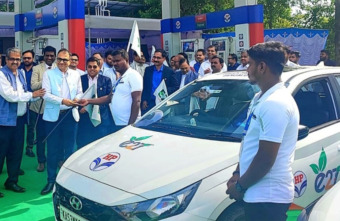
The pilot involves the participation of six vehicles, including a configuration of 1x4W and 2x2W for E27 fuel testing, 1x4W for EBD fuel testing, 1x3W for bioCNG fuel testing, and 1x4W for an E20 fuel study.
The pilot study of E27 fuel will focus on assessing its performance and emissions in engines and vehicles through extended mileage accumulation. Mileage accumulation of up to 10 000 km for two-wheelers and 20 000 km for passenger cars using E27 fuel is planned for this phase.
Ethanol trials, in accordance with IS 1460:2017 fuel specifications, will also be conducted in conjunction with biodiesel diesel.
Looking ahead, India’s next milestone in its ethanol blending program is achieving 27 percent ethanol blending.
According to HPCL, with the success of the ongoing trials and the achievement of E27 fuel, India will second Brazil on the global platform when it comes to the ethanol blending program.