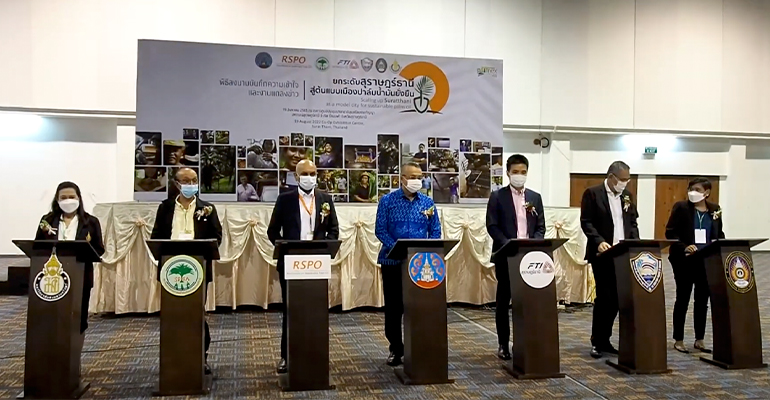
During the 2022 Asia Palm Oil Conference (APOC) / Palmex Thailand event in Surat Thani, the Roundtable on Sustainable Palm Oil (RSPO) Secretariat and Surat Thani Provincial Office signed a Memorandum of Understanding (MoU), providing a framework for cooperation and collaboration in support of scaling up Surat Thani as the national model city for sustainable palm oil in Thailand.
Thailand currently ranks third globally for crude palm oil (CPO) production with an estimated production of over 1.7 million tonnes expected in 2022.
Thailand has a combined plantation area of 992,000 ha, behind Indonesia (16.2 million ha) and Malaysia (6 million ha).
However, palm oil prices in Thailand have dropped for the past several years following the policy to promote palm oil, which increased plantation area but once supply outstripped demand, palm oil prices fell.
Palm oil Province
Surat Thai Province is home to hundreds of smallholders who are on a journey to be 100 percent RSPO certified.
Announced during the 2022 Asia Palm Oil Conference (APOC) / Palmex Thailand event in Surat Thani, RSPO and Surat Thani Province will work together towards common objectives, including the realization of sustainable palm oil development, helping stakeholders secure access to the global market, and enabling responsible palm oil entrepreneurs to obtain premium prices for their certified sustainable products.
For farmers, the collaboration is intended to improve their quality of life and ensure continuous compensation.
As such, smallholder coalitions such as the Community Enterprise Network of Sustainable Palm Oil Smallholders in Surat Thani are role models for palm oil growers in upholding the RSPO Principles and Criteria (P&C), such as implementing best practices, environmental responsibility, and commitment to continuous improvement.
According to Chaiwut Jitnupong, Chairman of the Surat Thani Oil Palm Farmers Association, work is underway to create a better relationship between large palm oil growers and smallholders.
Becoming an RSPO member will add to sustainability measures being taken seriously in the entire ecosystem. It allows us to understand the responsibility all players possess. This collaboration ensures the knowledge is passed down and careers are made sustainable with the entire supply chain getting what is deserved, Chaiwut Jitnupong added.
Future CSPO innovation and technology hub
Wichawut Jinto, Governor of Surat Thani Province said the palm oil city project is aimed at being an innovation and technology hub for local certified sustainable palm oil (CSPO), with the expectation of increasing value-added products, decent living wages, and access to premium markets.
Surat Thani is ready to raise itself to become a sustainable palm oil city because we have the assistance and cooperation of many agencies – government, private sector, civil society. Let’s come together to drive the development of palm and improve the quality of life for the farmers, Governor Wichawut Jinto said.
RSPO CEO Joseph D’Cruz echoed the importance of this partnership.
The world is facing rising food prices that are hitting poor and developing countries hardest. It is vital to increase collaboration between nations and international organizations to amplify our impact to better provide solutions. This partnership represents a positive move forward as it allows local stakeholders to collaborate with their governments, providing an ideal path towards sustainability and implementing the best management practices while curbing the negative impacts of unsustainable practices. In addition, it also enables the approach to solve sustainability problems at the grassroots level; optimizing the use of resources and sharing expertise within the jurisdiction, said Joseph D’Cruz.
Building on comparative advantages and ensuring their complementarity and mutual reinforcement, this partnership will contribute to meeting Surat Thani’s goal to be the national model city for sustainable palm oil.
The parties involved will work with palm oil producers, financial investors, and other stakeholders in their jurisdiction to promote sustainable growth and production of palm oil, focusing especially on inclusion by building sustainable models and helping to increase access to markets for certified sustainable palm oil (CSPO) and market commitment to CSPO.
The RSPO will share knowledge from existing case studies on jurisdictional approaches to certification to aid in the alignment of pipeline projects with jurisdictional commitments to RSPO certification.