To meet Europe’s demand for green hydrogen, governments and the private sector have high hopes for production in Africa. A study led by the Technical University of Munich (TUM) in Germany has now shown that the financing costs for production facilities in African countries would be much higher than previously assumed. Only 2 percent of around 10,000 investigated locations would be competitive for exports to Europe. This would require price and offtake guarantees from European governments.
Green hydrogen is considered a crucial component for climate-friendly industrial production, such as in the steel industry. Hydrogen is regarded as ‘green’ when the electrolysis used to produce it is powered by renewable energy sources.
As Europe is unlikely to be capable of meeting its own needs, the focus has shifted increasingly to Africa in recent years.
Governments and the private sector have high hopes that production sites for export could be developed in African coastal countries with favorable conditions for solar and wind power.
Uniform financing cost estimates despite specific country risks
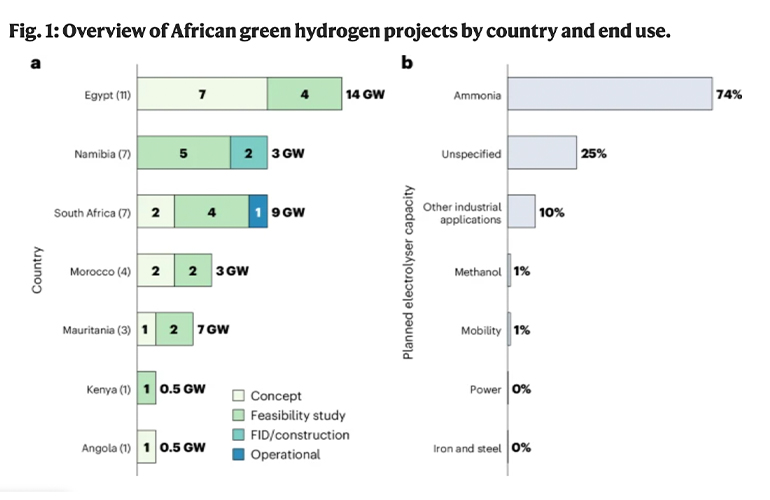
The first projects are currently being planned, although most plants are still in the concept development stages.
When analyzing these projects, researchers at TUM, the University of Oxford, the UK, and ETH Zurich, Switzerland, observed that the cost estimates were highly imprecise in many cases.
Most of the conventional models for green hydrogen plants typically use uniform financing costs. However, the investment environment is different in every country and is subject to especially high risks in many African countries, said Dr Florian Egli, who holds the Professorship for Public Policy for the Green Transition at TUM.
Consequently, the research team developed a new method for calculating the financing costs of green hydrogen production facilities. In other words, the costs for plant operators for raising capital for their investments.
This takes into account the specific conditions for hydrogen production in 31 African countries, including transportation and storage options, the degree of legal certainty, and political stability.
The model assumes that the production plants will be operational by 2030 and that the hydrogen will be converted into ammonia and shipped to Rotterdam.
The model and the results have been presented in a paper titled “Mapping the cost competitiveness of African green hydrogen imports to Europe“, and published in the journal Nature Energy.
Price of around €3 per kg only with guarantees
The study examines four scenarios in which general interest rates are either high or low and in which either plant operators assume all investment risks or policymakers issue price and offtake guarantees for the green hydrogen.
The research team’s calculations show that in the current interest rate environment, operators would have to pay around 8 percent interest on their financing at best, but possibly as much as 27 percent, depending on the scenario and country.
Most existing models had assumed a range of 4–8 percent, however.
On that basis, the research team calculated the overall production costs in Africa and the price of green hydrogen exported to Europe.
If the operators had to bear the investment risks alone at an interest rate corresponding to the current situation, the lowest possible price of hydrogen on the continent would be just under €5/kg.
In the case of guarantees by European governments and lower interest rates, the lowest possible price would decrease to a good €3/kg.
Even under these highly favorable conditions, African countries would face tough competition from other regions. For example, in a European Hydrogen Bank auction of subsidies for green hydrogen projects in Europe in 2024, the lowest price for a successful bid was below €3/kg.
Producing green hydrogen in Africa for export to Europe is much more expensive than previously believed. The past price calculations have not adequately reflected the socio-political risks, said Dr Stephanie Hirmer, a professor of climate-compatible growth at the University of Oxford.
Around 200 locations with potential for competitive production
The research team applied its model to more than 10,000 locations. Assuming that price and offtake guarantees are provided, only around 200 locations would come close to a price of €3/kg at today’s high interest rates and therefore have the potential of achieving economic competitiveness by 2030.
These locations are in Algeria, Kenya, Mauritania, Morocco, Namibia, and Sudan.
However, the study was only able to incorporate security risks at the national level. Because many otherwise optimal sites are located in insecure regions, the number of potentially competitive sites could be further decreased.
African production locations can be competitive for exports to Europe only if the European countries guarantee that they will purchase certain quantities of hydrogen at fixed prices.
Loan default guarantees, such as those provided by the World Bank, would also help. Only with policy instruments of this kind will it be possible to establish trade in green hydrogen from Africa to Europe, which might result in lower costs over time, said Dr Florian Egli.
Regardless of the cost issue, the researchers see stable agreements as a prerequisite for an industrial and development policy of African states geared toward long-term success.
It’s also about fairness. If the current hype is not backed up by meaningful political measures, we risk seeing projects developed that are neither cost-effective nor create added value for local populations, concluded Dr Stephanie Hirmer.