Jean-Paul Harreman, Director at Montel Analytics, a highly respected provider of data consultancy and information services to companies in the energy and power generation markets, has warned of intensifying energy system stress in Europe as soaring temperatures cause mismatches in electricity supply, demand, and flexibility.
In a new column released on July 2, 2025, Jean-Paul Harreman highlights how the ongoing heatwave across Europe is pushing an already stressed power grid, marked by negative daytime prices, soaring evening costs, and volatile balancing markets, to its limits.
As extreme weather events become more frequent, the grid’s current shape-sorting model is reaching its limits.
Without investment in flexible capacity and increased utilisation of demand response, the stress on the system and the cost of maintaining reliability will only increase.
Every part of the energy system is designed for a specific role, a particular ‘shape. But soaring temperatures are disrupting the balance. The result? Square pegs and round holes, said Harreman.
Soaring temps and demand create solar cliffs and price spikes
Temperatures are currently hovering between 5-10°C above seasonal norms across much of southern and western Europe, with highs regularly exceeding 35°C in parts of Spain and France.
This has driven a surge in electricity demand, particularly from air conditioning and cooling appliances during late afternoons and evenings.
This change in the demand curve creates earlier morning ramps, higher midday consumption, and sharper evening peaks, often misaligning with the times that renewables generate power.
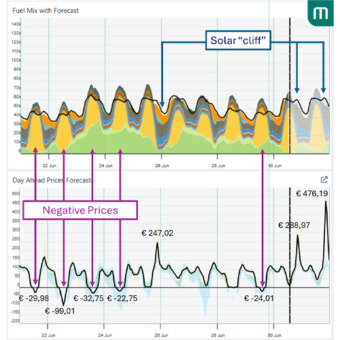
While solar output remains strong during daylight hours, it drops sharply in the evening, just as demand peaks.
This so-called “solar cliff” is creating major imbalances in the market.
Day-ahead prices in Germany and France have dipped to nearly EUR -100/MWh during peak solar hours, only to rebound above EUR 300/MWh by early evening.
The paradox is striking: abundance at noon, scarcity by night. It’s a daily EUR 300–400 swing, Harreman said
Fossil-fuel flexibility comes at a cost
In order to meet the evening demand, fossil fuel plants must then ramp up quickly.
Many of these power plants were never designed for frequent stop-start operations, leading to significant technical and economic costs when used to balance power grids in this manner.
Baseload generation faces heat-related challenges
It is not just renewables facing challenges during such conditions either. Nuclear output is also being reduced or modulated, sometimes due to cooling restrictions linked to higher river temperatures.
In France, EDF issued a public warning in late June that output at the Bugey nuclear plant might be reduced due to elevated water temperatures in the Rhône River.
French environmental regulations limit how warm discharged cooling water can be (to protect ecosystems), and those limits are approaching.
With air temperatures forecast to reach up to 38°C, river water is warming too. Other plants like Cruas and Saint-Alban, also located along the Rhône, are under close monitoring.
This isn’t the first time French nuclear output has been constrained by summer heat; it happened in 2019, and again in 2022.
However, the recurrence shows how climate stress is narrowing the operational envelope for what has traditionally been one of Europe’s most reliable baseload assets.
Nuclear is still running, but with less margin and more risk of modulation. At a time when every megawatt of firm capacity counts, this fragility matters.
Ancillary services under pressure
It’s not just energy prices that are spiking either. Both balancing and ancillary services markets’ reserves are showing acute stress.
In Germany, balancing auctions have cleared at twice the usual summer prices. In Italy, fast reserve procurements are fetching record highs.
These services are the early warning system. They tell us where the grid is truly feeling the strain, cautioned Jean-Paul Harreman.
Call for policy action
Harreman calls for immediate attention to long-term structural reform, noting that current market signals are clear, but investment incentives and policy responses are lagging.
Europe needs greater flexibility year-round – through storage, demand-side response, and smarter market design. The energy system is increasingly shaped not just by technology, but by climate… You don’t plan for average generation numbers, but for the extremes, that is what security-of-supply is all about, concluded Jean-Paul Harreman.