
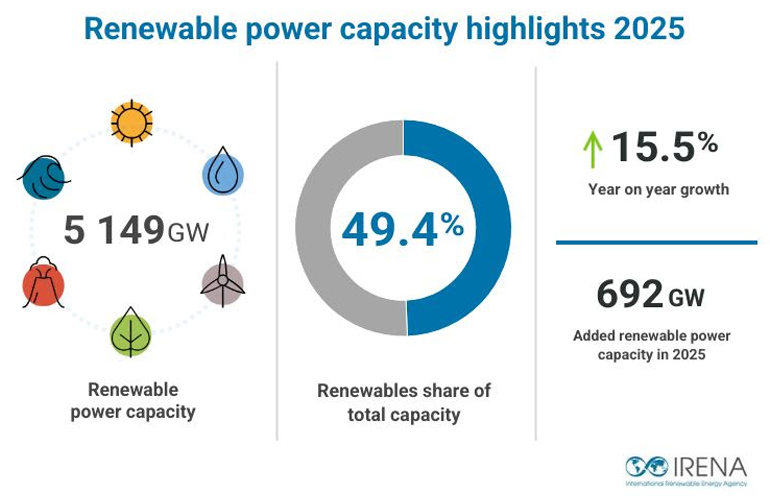
With the addition of 692 GW, 2025 saw total renewable power capacity reach 5,149 GW, or a 15.5 percent annual increase, according to a new report by the International Renewable Energy Agency (IRENA). IRENA's Renewable Capacity Statistics 2026 report also finds that renewable energy dominates the total power capacity expansion in 2025, at an 85.6 percent share, while non-renewables continue to account for a smaller share of additions.
Geopolitical tensions are once again thrusting energy into the global spotlight. Escalation in the Middle East raises fresh concerns over supply security and fossil fuel price volatility.
Against this backdrop, renewable energy is gaining attention in the build of more resilient systems that are less vulnerable to international shocks.
As renewables are homegrown, low-cost, and can be deployed immediately, increasing their share in national energy systems can reduce exposure to international fuel markets.
In the midst of uncertain times, renewable energy remains consistent and steadfast in its expansion. This not only indicates market preference but also makes a strong case for renewable energy resilience with brutal clarity. A more decentralised energy system, with a growing share of renewables and more market players, is structurally more resilient. Countries that invested in the energy transition are weathering this crisis with less economic damage, as they boost energy security, resilience, and competitiveness, commented Francesco La Camera, Director-General, IRENA.
Wind and solar continue to lead
According to the report, in line with the previous year, solar energy led the increase, accounting for 511 GW or approximately 75 percent share of the total renewables capacity addition.
Wind energy followed suit, adding 159 GW. Together, solar and wind accounted for 96.8 percent of all net renewable additions last year, reflecting the biggest cost decrease among all renewable technologies.
Bioenergy took third place with 2.3 percent annual growth, adding 3.4 GW to total renewable energy expansion.
Disparities persistent
The report also confirms, however, the persistent and significant disparities amongst countries and regions.
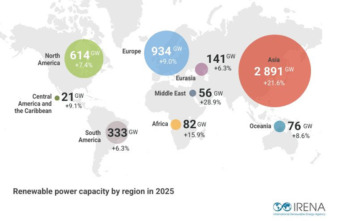
Asia continued to lead with a 74.2 percent contribution to all new renewable capacity; the 513.3 GW additions represent a growth rate of 21.6 percent.
Africa recorded its highest capacity increase, rising by 15.9 percent or adding 11.3 GW, driven by Ethiopia, South Africa, and Egypt. Another region that experienced its largest annual growth is the Middle East, which increased by 28.9 percent, led by Saudi Arabia.
In terms of total global capacity, Asia keeps its top position with 2,891 GW of renewable capacity, followed by Europe, which recorded 934 GW in 2025.
Central America and the Caribbean had the lowest renewables capacity with a total of 21 GW in 2025.
This disparity exposes the vulnerability of economies with a low share of renewables and underscores the urgent need to increase the renewable share for energy security.
Technology highlights:
- Solar energy: Solar photovoltaics (PV) accounted for 510.3 GW out of 511.2 GW of total solar energy additions in 2025.
- Renewable hydropower (excluding pumped hydro): 18.4 GW was added in 2025, with 96 percent of the increase coming from China. Ethiopia, India, Tanzania, Bhutan, Vietnam, Canada, Austria, Indonesia, and Nepal, respectively, added more than 0.5 GW.
- Wind energy: capacity grew by 14 percent from 2024, with record additions of 158.7 GW in 2025. China accounted for nearly three-quarters of the expansion, adding 119.4 GW, while India saw an increase of 6.3 GW.
- Bioenergy: capacity increased by 3.4 GW, led by Japan, which more than doubled its bioenergy capacity expansion from 2024, adding 1.1 GW in 2025. China followed with 0.8 GW of capacity additions and Brazil with 0.6 GW.
- Geothermal energy: capacity grew at a similar rate to the previous year at 1.7 percent, adding 0.3 GW in 2025. The Philippines and Indonesia each contributed 0.1 GW of the additions, followed by Germany, Türkiye, and Japan.
- Off-grid electricity (excluding Eurasia, Europe, and North America): expanded by 1.7 GW, led by solar power with 1.5 GW. A broad range of bioenergy types added 0.2 GW to the total addition of off-grid capacity.