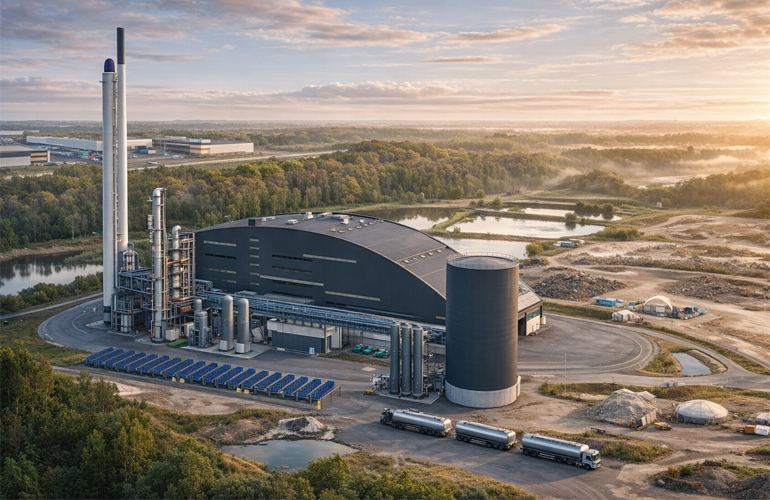
On May 19, 2026, the Helsingborg City Council in Sweden approved municipal energy company Öresundskraft AB’s investment in carbon capture and storage (CCS) at the waste-fired Filbornaverket combined heat and power (CHP) plant, giving the company the mandate to move forward with its CCS project.
At Filbornaverket, a Carbon Capture and Storage (CCS) facility is planned to capture approximately 200,000 tonnes of carbon dioxide (CO2) annually from district heating production — equivalent to the annual emissions from around 100,000 petrol-powered passenger cars.
Planned to be operational in 2029, Öresundskraft in Helsingborg will become one of the first energy companies in the world to implement carbon capture at a waste-to-energy combined heat and power plant.
CCS enables us to continue producing district heating and managing residual waste that cannot be materially recycled, but with very low emissions. In fact, even better than that, because the technology also gives us the opportunity to create negative emissions by removing carbon dioxide that is already in the atmosphere. The technology strengthens the role of district heating in the energy system and makes it possible to combine a secure energy supply with significantly reduced climate impact, said Stefan Håkansson, CEO of Öresundskraft.
Future-proofing district heating and waste management
As EU climate requirements become increasingly strict, pressure is growing on both waste management and energy production.
According to Öresundskraft, CCS provides a solution that addresses both challenges simultaneously.
Residual waste that cannot be materially recycled must still be managed, while emissions must continue to decrease.
CCS enables combining stricter climate requirements with the need for robust district heating and secure waste management — without increasing dependence on alternative fuels.
A key component in waste management
Plastics and other materials that can be materially recycled should, whenever possible, be sorted out for recycling, and recycling technologies continue to improve.
However, there will always be significant amounts of residual waste that cannot be recycled or repurposed, including certain plastics and hazardous waste.
At the same time, the EU aims to drastically reduce landfilling as a means of disposal by 2035. This means large volumes of non-recyclable residual waste will need to be managed differently.
This is where CCS at Filbornaverket becomes an important function in the future waste management system.
The technology enables handling residual waste that cannot be materially recycled while reducing fossil-fuel combustion emissions to very low levels.
As a result, Filbornaverket can play a dual role — both as a stable provider of local district heating and waste management, and as a contributor of practical experience to Europe’s transition toward a more sustainable waste management system.
Building the entire CCS value chain
Öresundskraft is not only building a capture facility, but also developing the entire CCS value chain, including transport and permanent storage of carbon dioxide. This creates the conditions needed to scale up and implement CCS for other stakeholders as well.
We are taking responsibility for driving this development forward. This is not only about our own facility, but about beginning to build the infrastructure and knowledge required for CCS to work at a larger scale. By taking responsibility for the entire chain — from capture to storage — and sharing our experiences, we want to create opportunities for more actors to transition, said Stefan Håkansson.
From political decision to implementation
The investment in Helsingborg demonstrates how long-term political decisions can be translated into concrete investments that develop and future-proof critical societal infrastructure.
By further developing Filbornaverket, the next step in the climate transition is being taken, while strengthening district heating and local waste management for the future.
The Helsingborg City Council decision means that Öresundskraft is now moving forward into the next phase of the project and taking further steps toward establishing CCS as an integrated part of the future energy system.