Rising geopolitical tensions, surging energy demand, and growing fossil fuel market volatility are reshaping the global energy landscape, opening a new phase of the global energy transition centred on electrification, renewable power, and the accelerated transition away from fossil fuels, according to a new report published by the International Renewable Energy Agency (IRENA).
In its new report, “Transitioning away from fossil fuels: A roadmap based on renewables, electrification and grid enhancement,” the International Renewable Energy Agency (IRENA) warns that beyond today’s energy security concerns, current energy systems remain structurally unprepared to meet the 1.5°C climate goal.
The report, released in collaboration with the Brazilian COP30 Presidency ahead of the Copenhagen Climate Ministerial, finds that whilst the global goals of tripling renewable power capacity and doubling energy efficiency improvements by 2030 remain essential, they are not alone sufficient to achieve the global energy transition.
As demand rapidly increases across transport, industry, buildings, and digitalisation, the transition must now focus on electrifying these end-use sectors while transitioning away from fossil fuels.
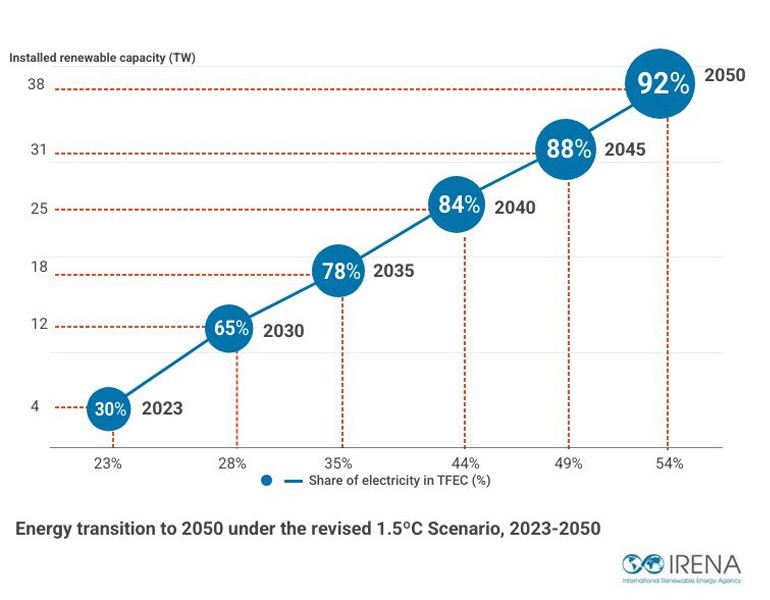
IRENA’s revised 1.5˚C Scenario in the forthcoming World Energy Transition Outlook projects global electricity consumption to rise from 23 percent today to 35 percent in 2035 and over 50 percent in 2050, with the rising demand mostly met by renewables.
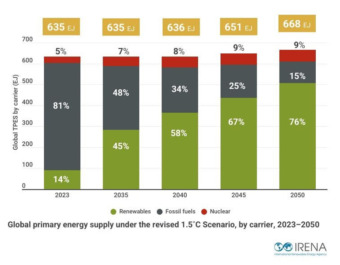
It envisages the share of fossil fuels declining across sectors from 80 percent today to 50 percent in 2035 and 20 percent or less in 2050.
The world must adapt to a new energy reality. Beyond the goals of tripling renewables and doubling energy efficiency lies the wider challenge of transforming entire energy systems and reducing fossil fuel use across supply and demand. Electrification and fossil fuel phase-out are inseparable and must advance together, said IRENA Director-General Francesco La Camera.
At COP28, the UAE Consensus and the First Global Stocktake under the Paris Agreement called for a tripling of renewables and doubling of energy efficiency by 2030. It also established an important foundation for the transition away from fossil fuels (TAFF).
The TAFF roadmap, launched by the COP30 Brazilian Presidency and supported by IRENA, provides an important pathway to advance climate, energy security, and development objectives in parallel.
IRENA’s revised roadmap clearly shows that electrification with renewables serves multiple policy goals. It contributes to climate mitigation, enhances energy security by boosting independence from imported fossil fuels, and bolsters economic competitiveness through the creation of new industrial value chains and innovation. Furthermore, cost-competitive renewables support affordable electricity prices for households and industry, Francesco La Camera added.
Electrification is a primary structural driver
The report highlights that electrification is becoming the primary structural driver of fossil fuel decline across all major end-use sectors.
Transitioning away from fossil fuels would mean a complete restructuring of energy infrastructure and investment allocation.
Countries must simultaneously invest in grids, storage, and system flexibility to ensure reliable, secure, and affordable electricity systems capable of supporting growing demand.
However, infrastructure has become a critical bottleneck, with around 2.5 TW of wind and solar awaiting connection to grids.
Upgrades by 2035 and 2050 will not be achieved without fast-tracked permitting and scaled-up investment. IRENA estimates grid investment needs at US$1.2 trillion per year on average, more than double the US$0.5 trillion invested in 2025.
Significant investments will also be needed in hydrogen and alternative fuels supply chains, as well as electrification of end-use technologies and their enabling infrastructure – from EV charging and building retrofits to construction for electric heating and cooling and industrial electrification.
The report also underlines the importance of monitoring progress on electrification, grid enhancement, and fossil fuel decline to support implementation and guide international cooperation.
The speed of the fossil fuel phase-out will ultimately be determined by how quickly economies electrify. To keep the 1.5°C goal within reach, the world needs a clear global direction of travel. IRENA data support the establishment of a global electrification target for 2035, complemented by targets for grids and system flexibility, concluded Francesco La Camera.