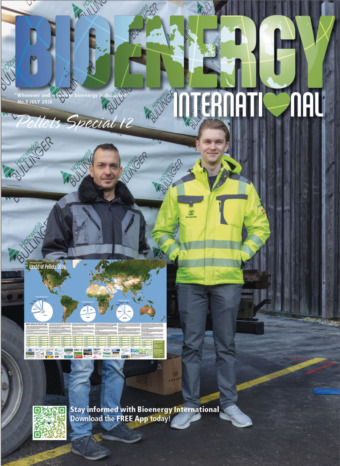
Bioenergy Europe has published its latest Pellet Statistical Report, providing a detailed overview of global and European pellet market trends and their role in the clean heat transition. Amongst other things, the report shows renewed momentum for the sector in 2025 with global pellet production and global pellet consumption recording strong growth.
According to the report, global wood pellet production reached 53.5 million tonnes in 2025, a 10 percent increase over 2024 and the strongest year-on-year growth in recent years.
Global pellet consumption also reached a new all-time high of 51.5 million tonnes, confirming the continued relevance of pellets across both industrial applications and small-scale heating.
Europe remains the world’s largest pellet-consuming region, representing 70 percent of global demand when industrial and small-scale uses are combined. It also continues to lead global production, accounting for 45 percent of world output.
After two consecutive years of contraction, European pellet production, excluding Belarus and Russia, increased by 10 percent to 24.1 million tonnes, setting a new regional record.
Growing role in Europe’s clean heat transition
According to Bioenergy Europe, its 2026 Pellet Report comes at a decisive moment for Europe’s heating sector.
In EU buildings, renewable energy sources represent around one-third of household heating consumption; however, fossil gas remains the dominant fuel. This underlines both the scale of the challenge and the opportunity.
Fossil fuel heating systems will need to be progressively replaced by renewable alternatives if Europe is to meet its 2030 and 2040 objectives.
Modern pellet heating systems can contribute to this shift by offering a renewable, cost-competitive solution that is resilient to geopolitical supply shocks.
Citizens, municipalities, and businesses can benefit from them, especially in rural areas, colder regions, and buildings where different clean heat options must work together.
Residential consumption and heating adoption
European small-scale pellet consumption reached more than 19 million tonnes in 2025, a new historical record.
Residential consumption alone rose to 15.3 million tonnes, increasing by 5 percent compared with 2024 after several years of more modest growth.
Across Europe, pellet appliances now provide renewable heating to more than 6.5 million households.
As Europe prepares a new EU Heating and Cooling Strategy in 2026, the Pellet Statistical Report shows that pellets are already part of the renewable heating landscape.
With stable market conditions and enabling public policy, the sector can help more households move away from fossil fuels while supporting Europe’s energy resilience and climate objectives.
In 2025, we have seen signs of recovery in pellet stove sales across several markets, highlighting that such appliances complement well the wider electrification trend in household heating. Well-designed public support can support households to address upfront investment costs for the replacement of their heating appliance, commented Manolis Karampinis, Business Development & Membership Director at Bioenergy Europe and General Manager of the European Pellet Council (EPC).