
As central Europe heads into the 2018/2019 heating season, new figures from the Austrian Pellets Association proPellets Austria for September show that although the price of residential quality wood pellets has increased by 3.7 percent compared to September 2017, on an energy basis the cost gap has widened further against fossil fuels.

According to proPellets, the Austrian average price of wood pellets is currently EUR 0.236 per kilogram (kg). In terms of energy content, natural gas is currently almost 67 percent more expensive than pellets whereas heating oil is almost 74 percent more costly for the consumer.
Compared to September 2017, the price of pellets has increased by 3.4 percent but the price increase for heating oil over the same period was, according to IWO-Austria, 22.6 percent.
Pellets decoupled from oil and gas
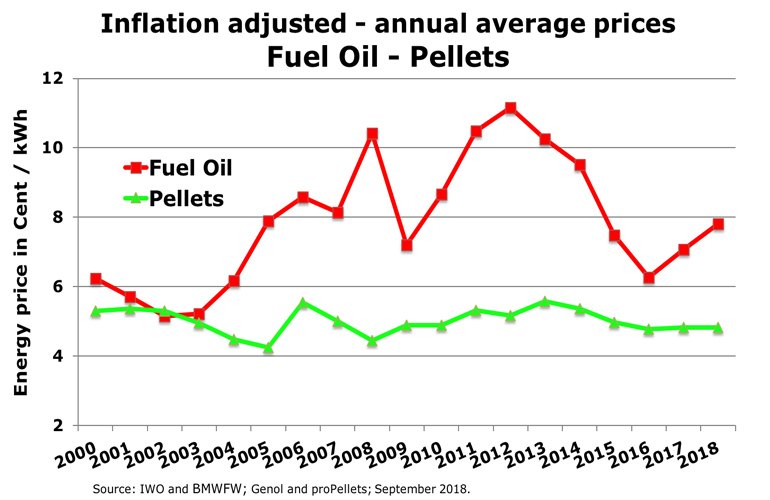
The organisation points out that this year again shows thus far that, contrary to a widespread myth, the prices of wood pellets do not follow the heating oil prices. Whilst there are seasonal differences during the year – many producers offer discounted spring pricing to consumers as a means of reducing carryover inventory into the following heating season – the annual average prices display remarkable stability in stark contrast to the volatile pricing of oil.

The average wood pellet price in 2012, after adjusting for inflation, was lower than the wood pellet price in 2002. One brief price peak occurred in 2006 as a consequence of the particularly cold and snowy winter, which caused logistical problems for the forest industry while at the same time demand increased rapidly. Woodchips and firewood remain the cheaper options.
In the meantime over 400 wood pellet plants have been built all over Europe. Production capacities in Austria have nearly doubled providing the country with an exceptionally high wood pellet self-sufficiency. The competition between the 43 or so producers ensures attractive and stable prices, which are not influenced by speculation or political crises.
Furthermore, the standardization of European quality standards, ENplus, has increased the permeability of the markets further strengthening the security of supply security and price stability.