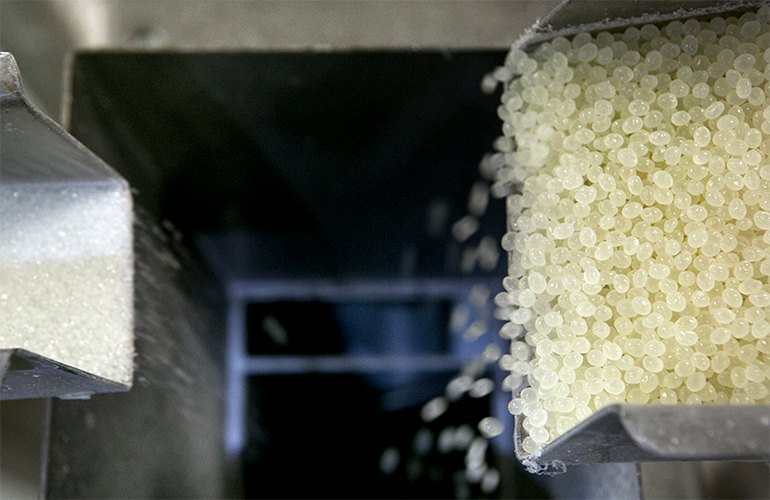
In Italy, biochemical and bioplastics major Novamont S.p.A held a reopening ceremony in Patrica for its revamped Mater–Biopolymer plant on October 19. The plant has been repurposed for the manufacture of ORIGO–BI biopolyesters with a high level of renewables and a component of Novamont's MATER-BI compostable bioplastics.
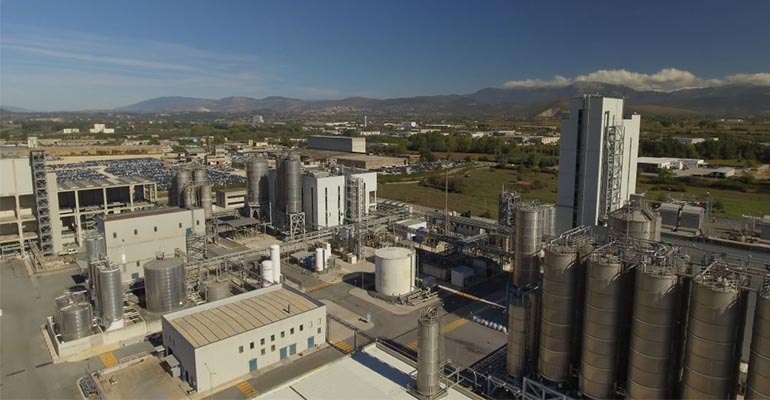
A former Mossi & Ghisolfi Group plant that produced polyethylene terephthalate (PET), the plant has been reconverted by Novamont to produce its ORIGO-BIO biopolyesters. The various sections of the plant have been regenerated, modified and in some cases totally renewed to implement innovative technologies developed by Novamont in the form of a continuous process.
These technologies are able to use the raw materials of Novamont’s system – biobutandiol and azelaic acid, bio-based monomers – to manufacture ORIGO-BIO biopolyesters through a process which Novamont says is increasingly sustainable, and directed towards reducing emissions.
The Mater-Biopolymer plant has a complex system of utilities which minimise costs and wastes through waste recovery. The circular economy and sustainability approach to the reutilisation of waste products has led to “the perfection” of a wastewater purification process to obtain the world’s first bio-based tetrahydrofuran (THF) – a chemical intermediary used in the chemical and pharmaceutical industries.
The reconversion of the second production line and THF recovery facility have generated significant environmental impact reductions by reducing carbon dioxide (CO2) emissions and avoided transportation and, according to Novamont, can be quantified as follows:
- 246 000 tonnes of avoided CO2 equivalent emissions per annum;
- 1 296 000 km of transport have been avoided, in comparison with the transport of THF-containing wastes which were disposed of off-site.
The plant is a further step forward in the local integrated biorefinery model championed by Novamont, which now has six interconnected reactivated sites, four proprietary technologies and a number of strongly innovative service plants which are in turn capable of producing new products.
Novamont’s industrialisation efforts over the last few years have been enormous and have few equals anywhere in Europe. But we need to be aware of the fact that what has been built so far is irrelevant if we do not know how to use it to increase the number of local regenerations to the point where these predominate over deterioration. All in all, we must work together towards a regenerative approach to natural resources, which should not be seen as a limitation but as a great opportunity to redesign our society on a sustainable basis with its roots in the land, more inclusively, where there is equal space for the big and the small. In all of this the world of agriculture and the soil and its preservation and regeneration are of vital importance. said Catia Bastioli, Managing Director, Novamont.