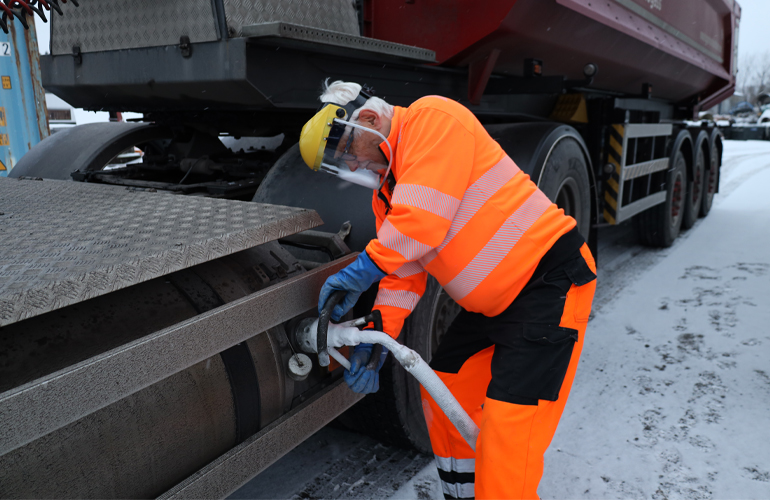
Nordic energy company Gasum Oy has announced that it has opened a new liquefied biomethane (bioLNG) filling section for heavy-duty vehicles (HDVs) at its existing station in Joensuu, Finland.
With the expansion, there will be an additional refuelling point for gas buses, and the operational reliability of compressed gas distribution will improve. The improvement is important for Savonlinja, which manages bus services in the Finnish city of Joensuu.
The Joensuu station has already been providing compressed biomethane (bioCNG) gas for lighter vehicles, and with the expansion, the station now also serves heavy-duty traffic.
It is Finland’s easternmost bioLNG filling station, and it will significantly improve the availability of bioLNG in Eastern Finland. With the opening of the Joensuu station, Gasum will now have a total of 23 stations in the bioLNG refuelling network for HDVs in Finland.
Over the past ten years, Gasum’s goal has been to build a comprehensive and efficient filling station network that supports the transition to a low-emission fuel alternative throughout the Finnish main road artery network. With the new station, more and more transport companies will have the opportunity to make the responsible choice of using biogas in logistics, said Juho Kurra, Head of Business, Traffic Finland, Gasum.
Improved operational reliability
The opening of the bioLNG section will also increase the operational reliability of bioCNG distribution, as the liquefied gas can be vaporised for distribution at the compressed gas station, if necessary.
An additional refuelling point for buses, opened in connection with the station expansion, will also bring additional relief.
Jukka Komulainen, Business Director at the bus company Savonlinja, is pleased with the expansion. In the past, the station has run out of gas from time to time.
The number of gas buses operated by Savonlinja will increase to 55 in August this year. The company uses them to operate local transport in several cities in Eastern Finland.
In the competitive tendering process for the routes, gas and electricity were prioritized by the City of Joensuu.
Komulainen says that because with bioLNG you can drive throughout the day, about 500–600 kilometres on one tank, gas was an easy choice for them.
Both drivers and customers have been satisfied. In addition, driving with bioLNG is circular economy at its best, because fuel is produced here in our own region from various waste streams. A gas bus is also a smaller investment than a similar electric vehicle, Jukka Komulainen said.