The European Commission (EC) has granted an Important Project of Common European Interest (IPCEI) status to the Green Fuels for Denmark (GFDK) project, a project that aims to produce large quantities of sustainable green fuels for road, maritime, and air transport in the Copenhagen area.
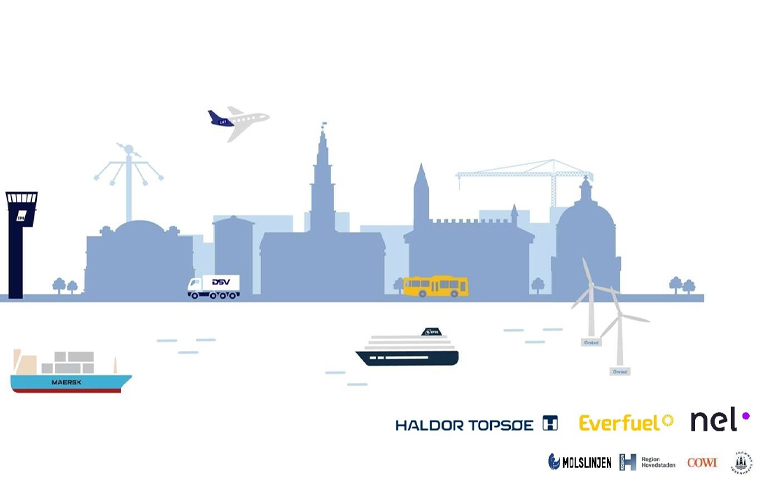
Green Fuels for Denmark (GFDK) is a major Power-to-X (PtX) project being developed by Denmark-headed energy utility major Ørsted A/S in partnership with leading off-takers in heavy road transport (DSV), shipping (Maersk and DFDS), and aviation (Copenhagen Airports, SAS).
Last year, the Danish government shortlisted GFDK as one of two Danish PtX projects eligible for public funding, provided that the European Commission (EC) recognizes it as an Important Project of Common European Interest (IPCEI), contributing to sustainable economic growth, job creation and the competitiveness of the EU economy.
We’re very pleased that Green Fuels for Denmark has been identified as being of common European interest. IPCEI is a key enabler for creating a green and energy-independent Europe, as it will unlock substantial amounts of funding to mature the Power-to-X industry, a central alternative to imported fossil fuels, said Olivia Breese, SVP and Head of P2X at Ørsted.
The Danish government has earmarked a total of DKK 850 million (≈ EUR 114.2 million) of funding for the two shortlisted projects.
The funding will help enable the consortium behind Green Fuels for Denmark to develop the first phases of the project as part of the industrialization of renewable hydrogen and green fuels needed to compete with fossil-based alternatives.
This and other IPCEI projects in our portfolio represent the second stage of our Power-to-X journey in which we start introducing large-scale facilities across four important sectors: refining, heavy industry, chemicals production, and heavy transport, Olivia Breese said.
The scale-up of Power-to-X is dependent on the availability of large-scale renewable electricity, and we urge governments across Europe to dramatically accelerate the deployment of offshore and onshore wind and solar PV in order to deliver on Europe’s ambition to lead in Power-to-X, added Olivia Breese.
According to Ørsted, PtX is emerging as a “cornerstone technology in the fight against climate change in the hard-to-abate sectors and as a clear, homegrown European industrial strength.”
Ørsted has set the ambition to become a global leader in renewable hydrogen and green fuels, and the company is building a strong and diverse portfolio of PtX projects across industries and geographies.
The European Commission’s decision to award IPCEI status to the flagship project Green Fuels for Denmark is “testimony to the strength and maturity of Ørsted’s Power-to-X pipeline which is based on concrete, feasible, and scalable projects in partnership with key off-takers.”
Located in Copenhagen, Denmark, GFDK aims to reach a total electrolysis capacity of 1.3 GW once fully developed.
The project is planned to be constructed in phases:
- Phase 1 (10 MW) will supply 1 000 tonnes per annum of renewable hydrogen for heavy road transport;
- Phase 2a (100 MW in total) will produce more than 50 000 tonnes of electro-fuels (eFuels) primarily e-methanol for shipping and enough e-jet – sustainable aviation fuel (SAF) – to potentially fuel Denmark’s first green domestic air connection;
- Phase 2b plans to reach 300-350 MW of cumulative capacity. When in full operation, phase 2b will produce more than 100 000 tonnes per annum of e-methanol and e-kerosene, equivalent to more than the total consumption of fuels for domestic aviation in Denmark;
- Phase 3 – the full 1.3 GW capacity – will be able to produce 275 000 tonnes of renewable fuels per year.
Subject to final investment decisions, phase 1 could enter commercial operations in 2023, phase 2a in 2025, and phase 2b in 2027.
In addition to Green Fuels for Denmark, three other Ørsted projects have been shortlisted in the IPCEI process:
- Haddock (the Netherlands), in collaboration with Yara;
- HySCALE100 (Germany), with several partners, and;
- Lingen Green Hydrogen (Germany), in partnership with bp.
The EU Commission is expected to finalize its IPCEI notification process by end of 2022.