Three industrial consortia – Northern Endurance Partnership, Net Zero Teesside, and Zero Carbon Humber – have secured further funding from the Industrial Strategy Challenge Fund to deliver the UK’s first decarbonized industrial clusters on the east coast of England. The three successful bids total £229 million (≈ EUR 267.6 million) in private and public funding and will accelerate the development of integrated onshore and offshore infrastructure for carbon emissions and low carbon hydrogen.
The bids from three industrial partnerships that will link together to deliver deep reductions in industrial emissions on the east coast of England have been awarded funding as part of the Industrial Decarbonisation Challenge under the UK Research and Innovation’s (UKRI) Industrial Strategy Challenge Fund (ISCF).
The three bids amount to GBP229 million (≈ EUR 267.6 million) in private and public funding, with industry contributing two-thirds of the total, and will support the next stage in the development of the three projects.
Accelerate transport and storage
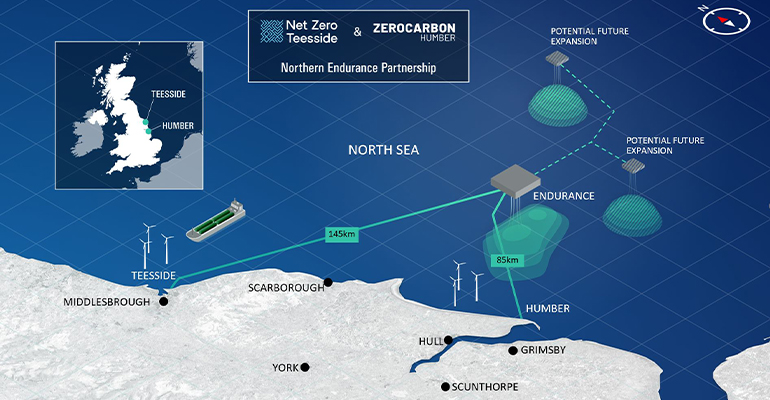
The Northern Endurance Partnership (NEP) will accelerate the development of an offshore pipeline network and geological storage in the UK Southern North Sea. Captured carbon dioxide (CO2) emissions from both the Net Zero Teesside (NZT) and Zero Carbon Humber (ZCH) projects will be transported and permanently stored deep underground in Endurance, the UK’s largest appraised saline aquifer for carbon storage.
These awards are great news for the UK. The Humber and Teesside make up nearly half of the UK’s industrial emissions so, to reach net zero, there is enormous value in tackling emissions at both clusters together. Rolling out carbon capture use & storage and hydrogen across the UK’s industrial clusters supports the Government’s aims for a green recovery and to level up by safeguarding and creating many high-skilled jobs, and will establish the UK as a world leader in hydrogen and low carbon technologies. As the UK’s leading energy provider, we will continue to work with our partners to progress our projects to final investment decision, engage locally and nationally to make this happen, Grete Tveit, SVP for Low Carbon Solutions at Equinor, which is a partner in ZCH, NZT, and NEP.
In Teesside, Net Zero Teesside (NZT) will develop a new flexible gas-fired power station with carbon capture (CC) and establish a CO2 gathering network to enable decarbonization of industrial emitters in the Teesside area.
In the Humber, the Zero Carbon Humber (ZCH) partnership will develop H2H Saltend, one of the world’s first at-scale low carbon hydrogen production plants, and a CO2 and hydrogen pipeline network connecting to industrial sites and gas and biomass power stations throughout the Humber, enabling them to capture their CO2 emissions and/or to switch to low carbon-hydrogen.
NZT and ZCH are at-scale projects that will kick-start the decarbonization of industry and power in two of the UK’s largest industrial clusters. Both projects aim to be commissioned by 2026 with realistic pathways to achieve net-zero through a combination of carbon capture and hydrogen.
If successful, the combined projects will support the decarbonization of nearly 50 percent of the UK’s industrial emissions.
I am pleased to welcome the Phase 2 funding the projects have received through the ISCF, which will help to accelerate key elements of onshore and offshore CCUS infrastructure on the east coast of England. This support for CCUS in the UK is critical to enabling projects such as NEP, NZT, and ZCH to enter Front-End Engineering Design (FEED), a crucial step forward as we look to develop the world’s first decarbonized industrial cluster by 2030. Public funding demonstrates Government commitment and increased ambition to establish the CCUS industry outlined in the recent Ten Point Plan and, along with clear Government policy, which is currently being developed, will unlock significant further investment from the private sector, commented Andy Lane, Managing Director, NEP, and NZT.
The Industrial Decarbonisation Challenge, funded as part of the ISCF, is the Government’s flagship challenge-led innovation programme, run through UK Research and Innovation (UKRI), a non-departmental public body sponsored by the Department for Business, Energy and Industrial Strategy (BEIS).
Around GBP2.6 billion (≈ EUR 3.04 billion) of public money has already been invested through the programme in projects from all sectors to tackle the big societal and industrial challenges of today.
These awards represent an important milestone as we look to decarbonize the UK’s largest industrial heartland and build a globally competitive platform for economic growth in the North of England. Teesside and the Humber offer the potential for a unique mix of technologies and scale to achieve net-zero, delivering significant value for money. National Grid will use our knowledge and experience of gas and electricity transmission infrastructure, and our capabilities developed on previous CCS projects, to deliver the infrastructure required to enable industry to achieve deep decarbonization, said Martin Cook, SVP for Business Development for National Grid Ventures, a partner in ZCH and NEP.