In Japan, advanced materials major Toray Industries, Inc., has announced that it has developed a proprietary technology to produce bio-based 2-pyrrolidone, a raw material in its polyamide 4, which delivers excellent biodegradability in marine and other environments and helps address microplastic issues.
With biodegradation, bacteria, fungi, and other microorganisms break down organic compounds into simpler inorganic substances, including water and carbon dioxide.
Biodegradation is generally slower in the sea, where microorganisms are less abundant than in the soil.
In recent years, ocean discharges of microplastics, plastic particles that are smaller than 5 mm, from cosmetics and facial cleansers, and secondary microplastic fragments from the degradation and fragmentation of items like plastic bottles and shopping bags owing to ultraviolet radiation and waves, have become a key environmental issue.
There are concerns about the adverse effects of microplastics on ecosystems and human health across the food chain, prompting various countries to restrict their use.
For example, the European Union (EU) amended its Registration, Evaluation, Authorization and Restriction of Chemicals (REACH) regulation in 2023 to prohibit the use of cosmetics and other products intentionally incorporating microplastics after a transition of six to 12 years.
The REACH regulation exempts plastics meeting specific biodegradability test standards.
Bio-based polyamide 4 meets REACH exemption
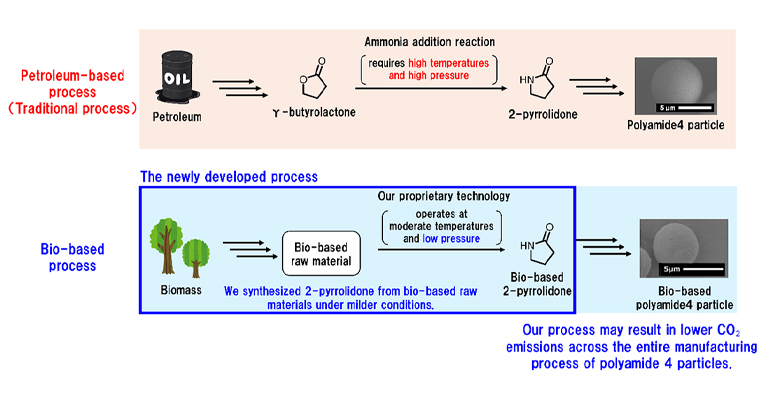
Against this backdrop, Toray set about developing and launching polyamide 4. The conventional feedstock for 2-pyrrolidone, the raw material in polyamide 4, is petroleum-based.
Toray embarked on R&D into synthesis approaches with sugars and other biomass sources, resulting in its bio-based version.
The sizes and shapes of polyamide 4 microparticles from polymerizing and processing 2-pyrrolidone with this technique are comparable to those of conventional offerings.
This bio-based feedstock conversion does not affect end products, and Toray’s polyamide 4 microparticles meet the OECD 301F ready biodegradability standard, thus meeting the EU REACH regulation exemption.
The company will use this technology to verify the scale-up of bio-based polyamide 4, with a view to offering it by the fiscal year ending March 2029, mainly for microparticles in foundation, eyeshadow, and other cosmetics.
Lower emissions
According to Toray, the reactions are milder than those of regular petrochemical processes, which should help lower carbon dioxide (CO2) emissions across the value chain, from raw materials through polyamide 4 microparticle production.
The applications of 2-pyrrolidone made with Toray’s technology extend well beyond polyamide 4.
It is also a feedstock for N-methylpyrrolidone, a liquid compound with a high boiling point, excellent chemical stability, and strong solvency for diverse compounds.
N-methylpyrrolidone is a common cleaning agent, paint stripper, and solvent, used extensively in manufacturing semiconductor materials and engineering plastics, and for N-vinylpyrrolidone, a monomer for high-performance polymers used in pharmaceuticals and other applications.
This opens the door to bio-based production across diverse materials supporting next-generation industries.
Results from Japan’s Ministry of Environment-funded Projects to Promote the Construction of Decarbonized Circular Economy Systems (FY2023 and FY2024) contributed to Toray’s technological breakthrough.