As climate change makes daily headlines, all available solutions to mitigate it must be thoroughly investigated and then deployed in an evidence-based way. Figures published by the European trade association Bioenergy Europe show that renewable energy consumption has steadily increased over the last decades, with bioenergy currently accounting for 63 percent of EU final renewable energy consumption. But both forestry and agricultural have the potential to do much more.

According to Bioenergy Europe, the time has come to take a step forward and use all means to achieve the 2050 climate goal. The Association has launched its “2019 Report on Biomass Supply“, with the latest data on forest resources, energy crops, land management and much more. Most of the figures are filtered by country and by type of source, helping policymakers and investors to better calibrate their decision-making.
Agricultural biomass in abandoned areas
Biomass is supplied from different organic sources such as wood, agricultural residues and crops, and organic waste. Around 70 percent of the overall biomass supply for energy is estimated to be sourced from the forest sector while biomass from agriculture and waste account for 18 percent and 12 percent respectively.
Bioenergy Europe points out that there are climate benefits to biomass, as well as plenty of economic and environmental impacts that are often overlooked. In the current state of play, the potential of agricultural biomass is largely unexploited due to mobilization issues.

Recent research shows how the overall energy contribution of sustainable bioenergy could triple by 2050 compared to the 144 Mtoe used in 2017, roughly equivalent to the total energy demand in Spain for the same year. Agricultural residues and crops could have a major role in driving this growth in the coming years if properly exploited.
In addition, the association highlights the opportunity of using unused and abandoned land areas in the EU to grow energy crops. Such unused lands representing 15.8 percent of the total land in EU28. By contrast, it is estimated that the land used to grow dedicated energy crops currently represents an area of 117 000 ha which is only around 0.03 percent of the EU28 land area, and equal to 0.2 percent of the current unused and abandoned areas.
By using these areas for energy crops, the production of bioenergy could be ramped up considerably and rapidly but to unleash this potential, favourable legislative frameworks need to be deployed. This will contribute to climate mitigation and adaptation as well as to job growth and rural development, Bioenergy Europe says.
Forest biomass
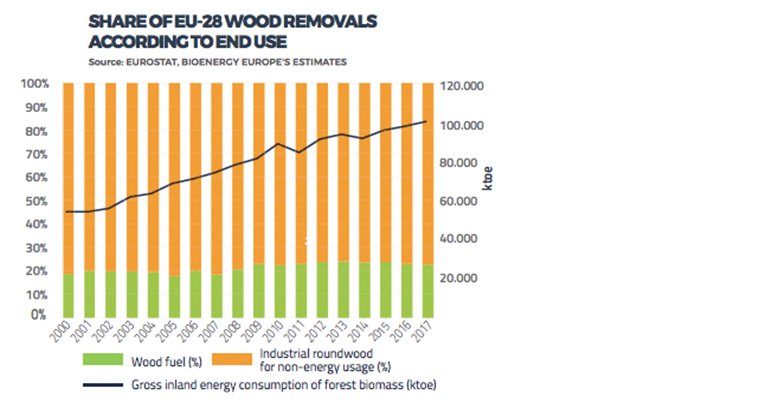
Over the last two decades, the forest area is increasing and more importantly, the annual growth of the European forest estate is consistently higher than the harvesting. In fact, more than 30 percent of the forest increment stays in the forest. Of wood removals, the pulp and paper industry and the construction industry together account for 77 percent while bioenergy accounts for the 23 percent balance.
Endangered by climate change, forests too have a key role in climate mitigation and adaptation. Proper forest management can lead to environmental, economic and social benefits, and slash the risk of forest fires and diseases, Bioenergy Europe highlights.