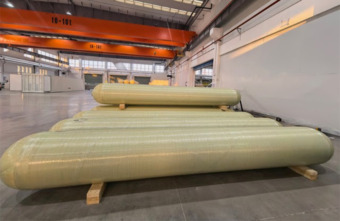
Norway-headed UMOE Advanced Composites AS (UAC), a global supplier of large Type IV glass fibre pressure gas storage and transportation modules, has announced that it has reached a key operational milestone with the first composite cylinders rolling off the production line at its new manufacturing facility in Jiaxing, China, marking the start of industrial production at the company’s largest global production base.
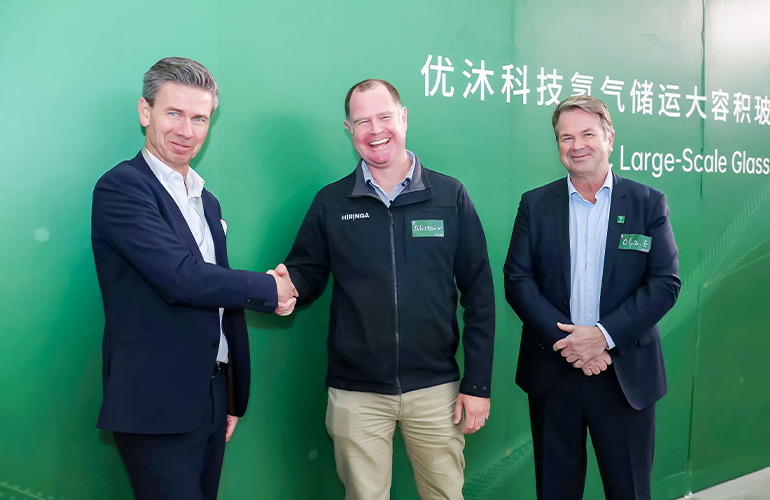
The Jiaxing facility will support the production of Multi-Element Gas Containers (MEGCs), including units delivered to Hiringa Sundown Joint Venture, for the Good Earth Green Hydrogen and Ammonia (GEGHA) Project, an integrated solar-powered hydrogen and ammonia project currently under construction in New South Wales (NSW), Australia, and designed to supply green ammonia and hydrogen for industrial and transport use.
Hiringa Sundown is a joint venture between New Zealand green hydrogen producer and infrastructure developer Hiringa Energy Ltd, and Sundown Pastoral Company, a privately owned Australian agricultural and pastoral company.
The project forms part of Hiringa Energy’s broader hydrogen infrastructure development across Australia and New Zealand.
The delivery comprises five MEGCs in total – two 20-foot and three 40-foot units – providing flexible, scalable storage capacity to support hydrogen transport and distribution within the project’s logistics infrastructure.
UAC has already supplied Type IV Multi-Element Gas Containers from Norway for Hiringa Energy’s first four hydrogen refuelling stations operating in New Zealand. That proven performance in our operating hydrogen refuelling network gives us confidence to source additional storage from UAC’s new state-of-the-art manufacturing facility in China for the Hiringa Sundown Joint Venture project in Australia. Access to the same high-quality, cost-competitive gas storage, produced closer to our markets, strengthens our ability to scale hydrogen infrastructure, said Alistair Tippett, Head of Projects & Engineering at Hiringa Energy.
Enable growth strategy
For UAC, the 12,000 m² facility in Jiaxing represents a significant step toward UAC’s global growth strategy and plays a central role in supporting the expansion of hydrogen and clean gas logistics across Asia and international markets.
Located in the Yangtze River Delta, approximately 100 km from Shanghai, the plant sits within one of China’s most dynamic industrial and hydrogen development clusters.
The region hosts a rapidly growing hydrogen ecosystem, including around 30 hydrogen refuelling stations along approximately 650 kilometres of major logistics routes serving heavy-duty vehicles (HDVs), ports and logistics fleets.
The site has a potential annual capacity of up to 20,000 composite cylinders. In parallel, the company is pursuing a special permit to enable domestic market distribution, supporting future deliveries within China.
Seeing our first cylinders roll off the production line in China is a huge milestone for UAC. This facility will, from the start, triple our global production capacity and create the foundation for future growth with potential for up to 24,000 cylinders per year across our operations in China and Norway. The Jiaxing facility enables us to deliver significantly higher capacity at a competitive cost level, strengthening our ability to serve customers globally as demand for hydrogen and other compressed gases accelerates, said Lars Erik Lunøe, CEO of UMOE Advanced Composites.
Also suitable for CNG applications
The combination of glass fibre composite technology and manufacturing in China strengthens the commercial viability of hydrogen projects by reducing storage and transport costs, supporting faster scaling of zero-emission mobility, shipping and industrial applications.
While the first MEGCs produced at the Jiaxing facility will be used for hydrogen storage, the same systems are also suitable for compressed natural gas (CNG) applications.
With production now underway, UAC is strengthening its ability to support the rapid expansion of hydrogen and clean gas logistics across Asia-Pacific and global markets.
Local manufacturing strengthens the commercial case for glass fibre cylinders in regions such as South America, the Middle East and Asia, as the hydrogen economy scales, energy systems evolve, and demand grows for cost-effective storage and transportation infrastructure.