Finnish concrete manufacturer Lakka Group has announced that it is investing in green concrete. The company plans to begin manufacturing significantly more climate-friendly concrete products at the beginning of 2026 by utilizing compatriot Carbonaide Oy's carbon dioxide-cured concrete technology.
The concrete industry accounts for 8 percent of anthropogenically induced carbon dioxide (CO2) emissions, with 90 percent of those stemming from cement production, the binder in concrete.
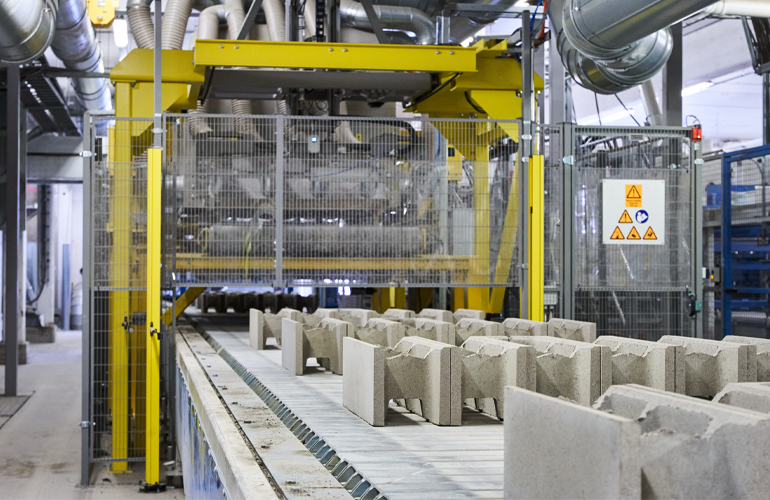
Lakka is adopting Carbonaide’s proprietary technology, in which cement is partially replaced with carbon dioxide. The CO2 is added during the concrete’s curing phase.
As the CO2 is permanently mineralized as carbonates into the concrete, the need for cement is reduced by 20-50 percent.
This is a multimillion-euro investment for us. Our goal is that within the next couple of years, half of the production at our Joensuu plant will utilize CO2 treatment. We will fairly quickly reach an annual pace of binding 1,000 tonnes of CO2. If the method were in use at all our plants, we could bind well over 10,000 tonnes of carbon dioxide into concrete, said Juho Hiltunen, CEO of Lakan Betoni, a Lakka Group company.
Apart from being cost-effective, the technology accelerates the manufacturing process, minimizes climate impact, and addresses the increasing industrial demand for low-carbon construction solutions.
In addition to carbon sequestration, carbonation accelerates the hardening of concrete by up to 50 percent, speeding up the entire production process. It also enables the use of entirely new types of binders. For example, slag generated during the production of stainless steel can be used as a substitute for cement. In that case, the concrete product could even become carbon-negative, said Tapio Vehmas, CEO of Carbonaide.
Drive toward low-carbon construction materials
According to Lakka Group, the construction industry, especially in Europe, is set to pivot toward low-carbon production and products driven primarily by CO2 taxation and market-based building regulations.
The price of cement has risen sharply in recent years, and at the same time, demand for environmentally friendly building materials has grown. Lakka’s investment comes at the right time in that sense—there’s clear interest. Retail chain customers have started to reach out. They, too, are setting climate goals, which naturally extend to the products they sell. As the leading manufacturer of concrete products for hardware store distribution in Finland, this investment will significantly decrease the carbon footprint of concrete products sold to consumers, Juho Hiltunen said.
For Carbonaide, founded in 2022, Lakka Group is the first customer to adopt the second-generation Carbonaide technology.
We were able to prove at Rakennusbetoni ja Elementti’s Hollola factory that the process works in an industrial setting. That plant is now operational, and Lakka’s investment will multiply the production capacity of carbonated concrete products in Finland. The company’s real growth markets are naturally outside of Finland. For international expansion, having solid domestic references is extremely important, concluded Tapio Vehmas, who originally started developing Carbonaide’s carbonation technology at VTT Technical Research Centre of Finland (VTT).