After seven years of planning and preparation, the ethanol factory in Sierra Leone is now up and running. The first litres of sugarcane ethanol were produced the first week of May, and the first kilowatt-hours of electricity were fed to the national power grid. Bioenergy International's Kjell Andersson was on the spot, as part of a study tour organised by ABBBA, the African Bioenergy & Biofuels Business Assessment.
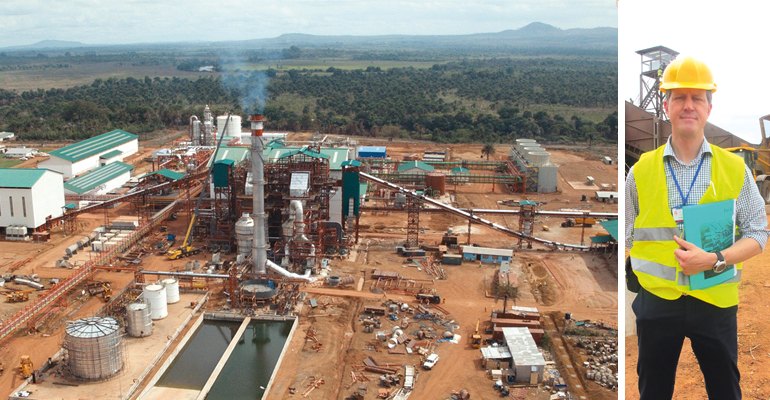
Sierra Leone. The ethanol factory in Mabilafu will produce 85 000 cubic metres of ethanol when it reaches full capacity. Jorgen Sandstrom, Executive Officer, Business Development and External Relations, Addax Bioenergy in Sierra Leone. The ethanol factory in Mabilafu will produce 85 000 cubic metres of ethanol when it reaches full capacity.
When the production reaches its full capacity in a couple of years the volume delivered from the new factory will be around 85 000 cubic metres of ethanol. Half of the produced electricity, 16 MW out of 32 MW, will be fed into the national power grid. That is a 20 percent addition to Sierra Leone’s current electricity supply. The ethanol will be delivered to local and international markets.
Addax Bioenergy’s project is located in inland Sierra Leone, 160 kilometres from the coast, near the city of Makeni. The factory site is close to the Rokel River, and the sugar cane area will total 10 000 hectares (ha) of centre-pivot irrigated fields. Total precipitation in Sierra Leone is over 3000 millimetres a year, but irrigation is needed during the dry season, to maximise sugar cane production. The total yield is expected to be around 100 tonnes/ha, which would give a total harvest of more than 1 million tonnes.
The project has been heavily criticised by global NGOs, accusing Addax Bioenergy of land-grabbing and endangering the local supply of food, as well as polluting water.
Addax Bioenergy’s project is unique in many ways. It is truly a greenfield project. Most other ethanol projects in developing countries are extensions of existing sugar estates. In Sierra Leone, there was nothing to build on. The country is one of the world’s least developed, with a low life expectancy and a high illiteracy rate. It has the highest malaria rate in Africa. On top of poverty, there was political unrest – a ten-years-long civil war, ended in 2001 with thousands of people killed and a devastated infrastructure.

The district where sugarcane is now growing was a remote rural district with subsistence farming in small villages with no access to roads. Rice was grown in lower-lying wet areas, known as bolis, and a typical yield was 300–500 kilograms per hectare, but much of the farming was based on slash-and-burn practices that had drastically reduced the forest areas. Land rights were traditional, with the chiefdoms holding the land in trust for the people, but no records on paper.

Today Addax Bioenergy is now ready to produce, as the first-of-a-kind plant in Africa. The company employs around 2 700 people, for planting and harvesting of sugar cane, for transport, and manning the factory. On top of that, there are 600 security personnel; theft of equipment and metals has been a major problem during the build-up of the project. Replacing lost equipment is a big cost, as everything has to be imported from far away.
The land is leased on long-term (50-year) contract from the villages. Originally Addax Bioenergy leased 54 000 hectares for exploration and planning. More than half of this has been relinguished, and the project area is now 24 600 hectares, of which less than half will be occupied by centre-pivot irrigated round sugarcane fields. The remaining area is occupied by fields used for local food production, trees, idle land, and riparian corridors for wildlife.
Payments to the landowners are done in three ways:
There is a general payment of US$8.89 per hectare/year for all land, according to the Land Lease Contract signed in 2010, divided up this way:
- 50 percent goes to the landowners in the villages
- 20 percent goes to the chiefdoms (there are three chiefdoms in the area)
- 20 percent goes to the local districts
- 10 percent goes to the government
Special agreements have also been made with every land-owning family, called Acknowledgement Agreements, giving an extra US$3.46 per ha. This means that landowners get US$7.90, or 64 percent of the money. And this money goes directly to the people out in the villages, in cash every March.
On top of this Addax Bioenergy has paid compensation for assets in the areas now occupied by the sugarcane fields and other installations. These assets are mainly fields and economic trees, like mango trees and oil palms. The villages have been left untouched – no people, except seven pastoralist families, have been relocated. One village has used the income to relocate themselves to a healthier spot in the terrain.
In order to give the right compensation and land lease right and rent to each landowner, a land survey was made of the whole area, and the resulting maps and boundaries were registered.
Altogether, the wages, land-leases and other payments, means that over US$20 million is fed into the local economy every year.
Besides the direct payments, the local community is also benefitting from the improved infrastructure. Addax Bioenergy has built 380 kilometres of roads in the area.
The effects of the improved economy can be clearly seen in the villages. The houses are getting new tin roofs, an important improvement in a country with much rainfall. New houses are being built, small stores are being opened, etc. Some people worry that too much money is coming into the area too quickly. The absence of local banks makes it hard to manage the money.
Another affect is that people start asking what the chiefdoms and district do with their share of the money. Schools and health service are badly needed, but are not part of the commitment from Addax.
To guarantee food production in the area, Addax Bioenergy has introduced better farming practices through its Farmer Development Programme (FDP), giving education to more than 2000 farmers 60 percent of them women, in farm schools, and helping the farmers establishing fields with higher productivity, ploughing, harrowing, and offering better quality seeds. Yields have risen to 1 200 kg per ha, still very low yields compared to European standard, but double the level from before.
An issue brought up by the local stakeholders is that people out in the villages do not always take full advantage of the Farmer Development Programme. The rice needs to be weeded, and in some cases this is not done. A reason could be that the sown areas are too big, or that the service has been free. After three years of free FDP services a new program, Farmer Development Service (FDS), takes over, to ensure sustainability of the approach. The farmers now have to pay for ploughing, harrowing and harvest services. To improve the nutrition, a kitchen garden programme has also been introduced, with a strong focus on women farmers.
Is everyone satisfied with the situation? The people who got jobs with Addax, and the families who get land lease money are glad. But not everyone got a job, and some lost their jobs, for different reasons. The villages that were originally in the lease area, but whose land is no longer needed, are dissatisfied when they see the money going to their neighbours. Villages across the river want to join in, but the project is limited. Much new money in the area creates mostly winners, but also some losers and some envy.

– For me as chief, I see Addax as one of the institutions that can help us to develop our country. We can benefit from each other. It gives jobs for the people. I see the project as a success story, successful to 90 percent. When we negotiated about the land and the leases, both sides had lawyers, because you cannot negotiate with lawyers if you are a layman. I do not foresee any problems with the land issue.
His speaker points out that many of the villages outside the Addax area today ask Addax to come to them and lease land. Full support from the paramount chiefBai Sebora Kasangna, Paramount chief of Bombali Sebora, here with his speaker and assistant, PA Messalieh Conteh. He says: – For me as chief, I see Addax as one of the institutions that can help us to develop our country. We can benefit from each other. It gives jobs for the people. I see the project as a success story, successful to 90 percent. – When we negotiated about the land and the leases, both sides had lawyers, because you cannot negotiate with lawyers if you are a layman. I do not foresee any problems with the land issue. His speaker points out that many of the villages outside the Addax area today ask Addax to come to them and lease land.

Accusations of land-grabbing and food shortage
The Addax Bioenergy investment in Sierra Leona has been subject to accusations related to “land-grabbing” and “threat to food security” from the start. An array of NGOs and some researchers have published reports with these accusations, often based on limited empirical data and selective interviews. Oakland Institute, ActionAid, Oxfam, Bread for all, and local groups like SiLNoRF (Sierra Leone Network on the Right to Food), are among these. The criticism has also reached global media, like the Economist, the Guardian and others. It has more or less become a known fact in many circles that Addax is a neo-colonial threat to the people of Sierra Leone.
What is the truth behind these accusations?
The ABBBA study tour met with NGOs and stakeholders both locally and in the capital Freetown. The views differed drastically between these groups. It was hard to believe that they spoke about the same project. Almost all of the local representatives gave full support to the project and had no major criticism. No talk of landgrabbing or shortage of food.
In Freetown, some of the NGOs were sure that the local people in Makeni District were poorly paid and badly compensated by Addax Bioenergy, and the modern large-scale farming was dismissed as “alien to the traditional culture”. When asked about the opposite view given by the local NGOs, the people in Freetown said that they were the true representatives of the people and that the locals were too dependant on Addax Bioenergy to give a fair view of the situation.
Many of the global organisations, researchers and media who have written about Addax have not bothered to visit Sierra Leone and see for themselves what is going on. They have to a large extent relied on second-hand information.
Representatives from government ministries and agencies in Freetown are positive to the project and the investment. We met with some of these.
A few months ago, Addax Bioenergy was certified by the Roundtable on Sustainable Biomaterials (RSB). An independent audit was made by DNV (Det Norske Veritas), a process where the auditors spent 13 days at the site and in the area and investigated all complaints which had been raised by various NGOs. In no case did DNV find that the accusations were valid. The complaints concerned issues like lack of legal support for the communities, food security and loss of water.
The project has been financed by a number of financial institutions, among them the African Development Bank, the German Investment Corporation (DEG), and Swedish Swedfund. All of these institutions have their own social and environmental standards. Numerous studies were made before the project started, to evaluate risks and identify issues that had to be dealt with.

The participants in the study tour: Christian Tucker, African Development Bank, Sierra Leone, Lars-Olle Larsson, Swedfund, Sweden, Thomson Sinkala, Zambia Bioenergy, Zambia, Hanna Begler, ABBBA, Sweden, Franklin Maguge, Webco, Kenya, Jörgen Sandström, Addax Bioenergy, Sierra Leone, Yvonne Aiko, CASDA, Kenya, Mattias Goldmann, ABBBA, Sweden, Jan Wärnbäck, WWF, Sweden, and Kjell Andersson, Svebio and Bioenergy International, Sweden. ABBBA stands for African Bioenergy & Biofuels Business Assessment and is a project aimed at promoting development of biofuels, bioenergy and forestry in Africa, and to act as a mediator between African actors and Nordic companies, hopefully leading to new investments. ABBBA is co-funded by Sida, the Swedish International Developments Cooperation Agency. The participants in the study tour: Christian Tucker, African Development Bank, Sierra Leone, Lars-Olle Larsson, Swedfund, Sweden, Thomson Sinkala, Zambia Bioenergy, Zambia, Hanna Begler, ABBBA, Sweden, Franklin Maguge, Webco, Kenya, Jörgen Sandström, Addax Bioenergy, Sierra Leone, Yvonne Aiko, CASDA, Kenya, Mattias Goldmann, ABBBA, Sweden, Jan Wärnbäck, WWF, Sweden, and Kjell Andersson, Svebio and Bioenergy International, Sweden.
Facts
Suppliers to the project
Main project entrepreneur:
De Smet Engineers and Contactors – EPCM services contract. De Smet site management and supervisor of major Trade Contractors
Major Trade Contractors:
CSL (Civil Works)
PRAJ (Ethanol Process and Water Treatment Plant)
ISGEC (Power Plant, Cane Processing and Milling)
Forges Tardieu (Erection, Clarification, Evaporation, Fire Fighting, Racks and Cooling Towers)
JVC (Electrical and instrumentation installation)
SOFMAN (Cladding and Roofing)
Technord (low voltage automation control)
Agricane – General contractor agriculture
Addax Bioenergy is a subsidiary of Addax Oryx Group, a private company, active mainly in exploration and distribution of oil, with a focus on Africa.