
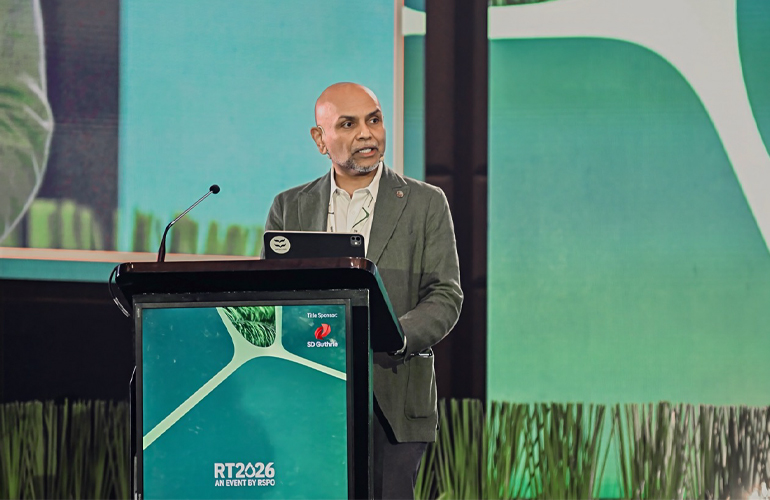
The Annual Roundtable on Sustainable Palm Oil (RT2026) brought together global stakeholders to mobilise action for a more sustainable palm oil industry, ensuring that RSPO’s foundational mandate continues to deliver real environmental and social progress amid shifting geopolitical and market conditions.
Held in Jakarta on November 3-4, 2026, the annual Roundtable on Sustainable Palm Oil (RSPO) flagship conference took place at a challenging period for Indonesia.
Amidst one of the strongest El Niño events on record, land and forest fires have burned more than 1.9 million hectares across the archipelago between January and September 2026, according to satellite analysis by Nusantara Atlas.
During his RT2026 keynote address, RSPO CEO Joseph D’Cruz addressed public criticism of the sector, while recognising RSPO members’ efforts to fight the fires on the frontlines in Sumatera and Kalimantan.
We are not an industry hiding from scrutiny. We are a partnership that monitors ourselves more closely than anyone else monitors us. If specific concessions show unusual burning, we will identify them and investigate. Furthermore, analysis shows that there has been almost no land burned in RSPO Certified independent smallholder plots. There is no data or evidence so far that any RSPO Certified unit deliberately lit fires, Joseph D’Cruz said.
Dr David Gaveau, founder of TheTreeMap, presented preliminary satellite monitoring data from Nusantara Atlas for January to September 2026.
When we look at fires within RSPO Certified concessions and cross-check those numbers with RSPO, we find 14,500 hectares of land burned or affected by fire in these concessions. This represents roughly 0.8 percent of the 1.9 million hectares burned across Indonesia in 2026, Dr David Gaveau said.
Joseph D’Cruz urged RSPO Members to leverage the data, facts, and evidence available.
We must all show willingness to stand on what we have built. When we stay silent, we let the worst actors define our industry and undermine two decades of hard work, and let a system that millions of livelihoods depend on be devalued by people who never understood it, stressed Joseph D’Cruz.
Connecting independent smallholders with buyers
Nowhere are rural livelihoods more visible than among the smallholders who produce nearly half of Indonesia’s palm oil.
The country is home to 77 percent of the world’s RSPO Certified smallholders. RT2026 recognised 45 new independent smallholder groups from Colombia, Indonesia, Malaysia, Peru, and Thailand who have completed their initial RSPO Certification.
Additionally, the RSPO Independent Smallholder Business Matching event connected potential Credits buyers with independent smallholders from around the world.
RSPO recognised outstanding members for their smallholder support through RSPO Credit purchases made from November 2025 to September 2026: Kao Corporation, Nestlé S.A., and Unilever PLC, alongside leading first-time buyer Lakeland Dairies Co-operative Society Ltd and Pitak Palm Oil Company Ltd.
Single Export Gate for sustainable palm oil
Indonesia’s Single Export Gate is one of the sector’s most significant developments, reshaping the global export landscape for Indonesian palm oil.
In 2026, Danantara Indonesia, the state investment agency, established PT Danantara Sumberdaya Indonesia (DSI) to oversee and process exports of strategic commodities.
Within this framework, Luke Mahony, CEO of DSI, explained in a Special Dialogue how the new system and sustainable palm oil can work as complementary levers to build trust in global markets.
We welcome this dialogue with RSPO because sustainability and market access must go hand in hand. DSI’s mandate is clear: we facilitate, we do not obstruct. We are here to uphold industry standards, simplify compliance, and strengthen global confidence in Indonesian palm oil, remarked Luke Mahony.
DSI aims to bring transparency and credibility to Indonesia’s commodity markets, drawing on existing data in the ecosystem and combining it with market realities, including sustainability from the RSPO perspective, supply, price, and production.
Under the DSI’s intermediary model launching in January 2027, buyers and sellers maintain their relationship, while DSI protects export continuity and preserves the traceability chain.