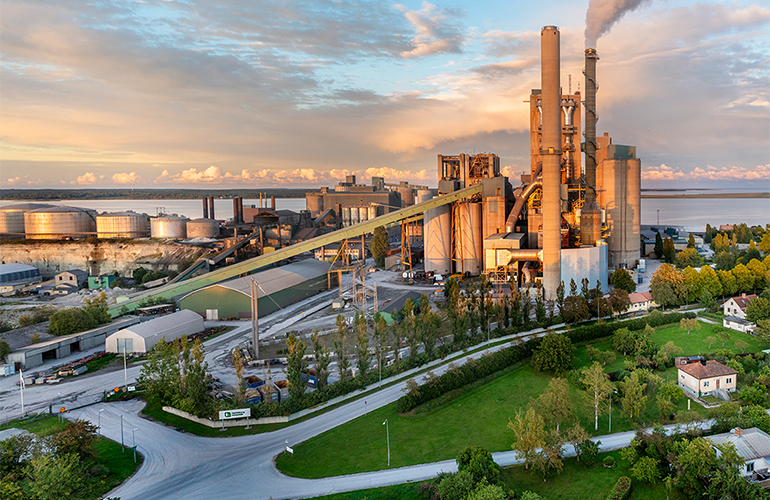
In Sweden, Heidelberg Materials Sverige AB, part of Germany-headed global construction materials major Heidelberg Materials AG, has announced that it has submitted an application to build one of Europe's largest carbon capture and storage (CCS) facilities to capture carbon dioxide from its cement production facility in Slite on the island of Gotland. The permit application also seeks permission to rebuild Slite Harbor to enable the transportation of captured carbon dioxide to the sequestration site.
Heidelberg Materials is moving forward with CCS plant plans at its Slite cement facility and has applied to the Land and Environment Court for permission to capture the carbon dioxide (CO2) emissions generated during the cement manufacturing process.
Using bio-based fuels and carbon capture, the cement plant is being retooled to produce cement with zero net emissions.
Fully deployed, the investment would capture 1.8 million tonnes of CO2 annually reducing Sweden’s current CO2 emissions by an estimated 4 percent.
CCS is a crucial technology
According to Heidelberg Materials Sverige, CCS is a crucial technology for the cement industry to reach zero net emissions.
With a strong increase in the bio content of the fuel mix and continuing to develop climate-improved cement products on a large scale through the use of new materials, the Slite site has the potential to create a significant carbon sink.
Here, the company says that it will combine CCS technology with a higher proportion of bio-based fuels than any other cement plant in Europe.
Thanks to several innovations such as a fully electrified amine-based capture process, a land-based compression and liquefaction technology, and large-scale efficient energy recovery, the planned facility in Slite will be unparalleled in the industry.
Slite CCS is innovation at the absolute global forefront. Here, we drive technical development in order to seriously succeed in creating large-scale cement production at the forefront of climate change. With the help of bio-based fuels, we reach beyond net zero and create a significant carbon sink, said Karin Comstedt Webb, VP of Heidelberg Materials Sverige.
Subsea bedrock sequestration
The captured CO2 will be liquefied through cooling and pressurization and then loaded onto purpose-built vessels with closed tanks for onward transport to sites for permanent geological storage.
Several storage sites are under development in the North Sea that may be relevant to storing CO2 from the Slite site from 2030.
The storage takes place kilometers deep in the subsea bedrock where the CO2 is mineralized over time and becomes part of the bedrock.
The existing harbor and entrance to Slite need to be widened and deepened to dock ships that will transport the liquefied CO2. A new pier will be built to ensure efficient logistics for the transportation.
More and more basic pieces are now falling into place for the conversion of one of Europe’s largest cement factories. The issue of carbon dioxide shipping across borders has been resolved, the expansion of the electricity grid on and to Gotland is proceeding rapidly, and demand for the products is increasing. Therefore, it feels gratifying that today we are taking a big step towards making it possible for large parts of the Swedish civil engineering sector to build in concrete without a climate footprint as early as 2030, Karin Comstedt Webb said.
The investment in Slite is a further development and upscaling of the CCS investment in Brevik, Norway where Heidelberg Materials Norge is establishing the world’s first CCS value chain on an industrial scale in the cement industry.