France-headed global waste management and resources major SUEZ Group (SUEZ) and German organic waste pyrolysis solutions provider PYREG GmbH have announced the deployment of "Pyrolis S2B", an innovative integrated solution for pyrocarbonisation of sewage sludge into biochar, offering a sustainable carbon sequestration solution while supporting the circular economy.
Approximately 340 million tonnes of industrial and agricultural effluents, including municipal wastewater sludge, are generated annually in France.
The effective management, treatment, and valorisation of these effluents represent an increasing environmental challenge.
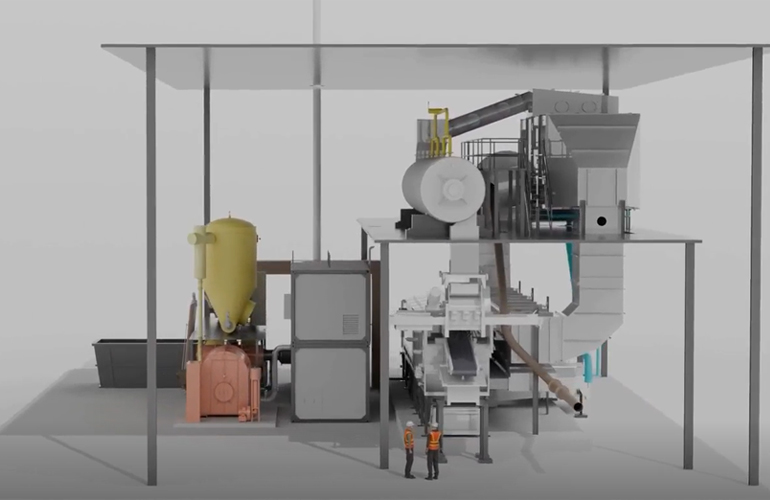
SUEZ and PYREG have developed the Pyrolis S2B pyrocarbonisation process, which integrates drying and pyrolysis of organic waste within a single unit, enabling the transformation of dewatered sludge into biochar.
This technology, adaptable to all types of infrastructure, significantly reduces the volume of waste derived from municipal and industrial wastewater while permanently sequestering the carbon contained within these residues.
Pyrolis S2B is a milestone: by combining our reactor technology with SUEZ’s infrastructure expertise, we are delivering an immediately scalable solution for operators worldwide. We enable municipalities and industry to transform challenging waste streams into valuable, carbon-negative resources—efficiently and reliably, said Alexander Friedrichkeit, CSO and Member of the Executive Management of PYREG.
An integrated, autothermal, compact, and modular process
Dewatered sludge is initially dried using a low-energy technology developed by SUEZ to achieve 90 percent dry solids content.
The dried sludge is then fed into the PYREG reactor technology, where it undergoes pyrolysis—the heating of organic material to approximately 600 °C in a low-oxygen environment.
This produces a stable, carbon-rich biochar that is free of PFAS and a hydrocarbon-rich pyrolysis gas.
The pyrolysis gas is subsequently fully oxidised at temperatures exceeding 950 °C, generating heat to sustain both the low-energy drying stage and the pyrolysis itself, thus optimising the plant’s overall energy efficiency.
High-temperature oxidation also destroys any residual Per- and PolyFluoroAlkyl Substances (PFAS) present in the pyrolysis gas.
High-value biochar
Biochar produced via the Pyrolis S2B process is recognised by the Intergovernmental Panel on Climate Change (IPCC) as an effective climate change mitigation tool due to its capacity for stable carbon sequestration.
It also serves as a soil amendment, rich in phosphorus and free from contaminants such as PFAS, microplastics, dioxins, pharmaceutical and narcotic residues.
This biochar enhances nutrient and water retention, aeration, drainage, and microbial activity in soils. It promotes soil regeneration, improves fertiliser efficiency, and increases agricultural yields—offering significant benefits to the farming sector.
Moreover, it is a valuable additive in the construction industry. Incorporated into concrete, cement, or asphalt, it enhances material performance while substantially lowering their carbon footprint.
The durable carbon sequestration facilitated by biochar further qualifies it for inclusion in carbon credit schemes.
A strategic partnership to accelerate the ecological transition
This partnership combines SUEZ’s longstanding expertise in thermal sludge treatment technologies with PYREG’s world-leading know-how in organic waste pyrolysis.
It embodies a collaborative innovation approach dedicated to ecological transition and circular economy principles.
We are proud to collaborate with PYREG in offering an innovative pyrocarbonisation technology that not only processes sewage sludge effectively but also produces biochar—a sustainable carbon sequestration solution. This partnership showcases SUEZ’s capacity to develop advanced water treatment processes while accelerating the sustainable valorisation of critical resources, said Grégory Tesse, Infrastructure and Innovation Director of the Engineering & Construction activities of SUEZ.